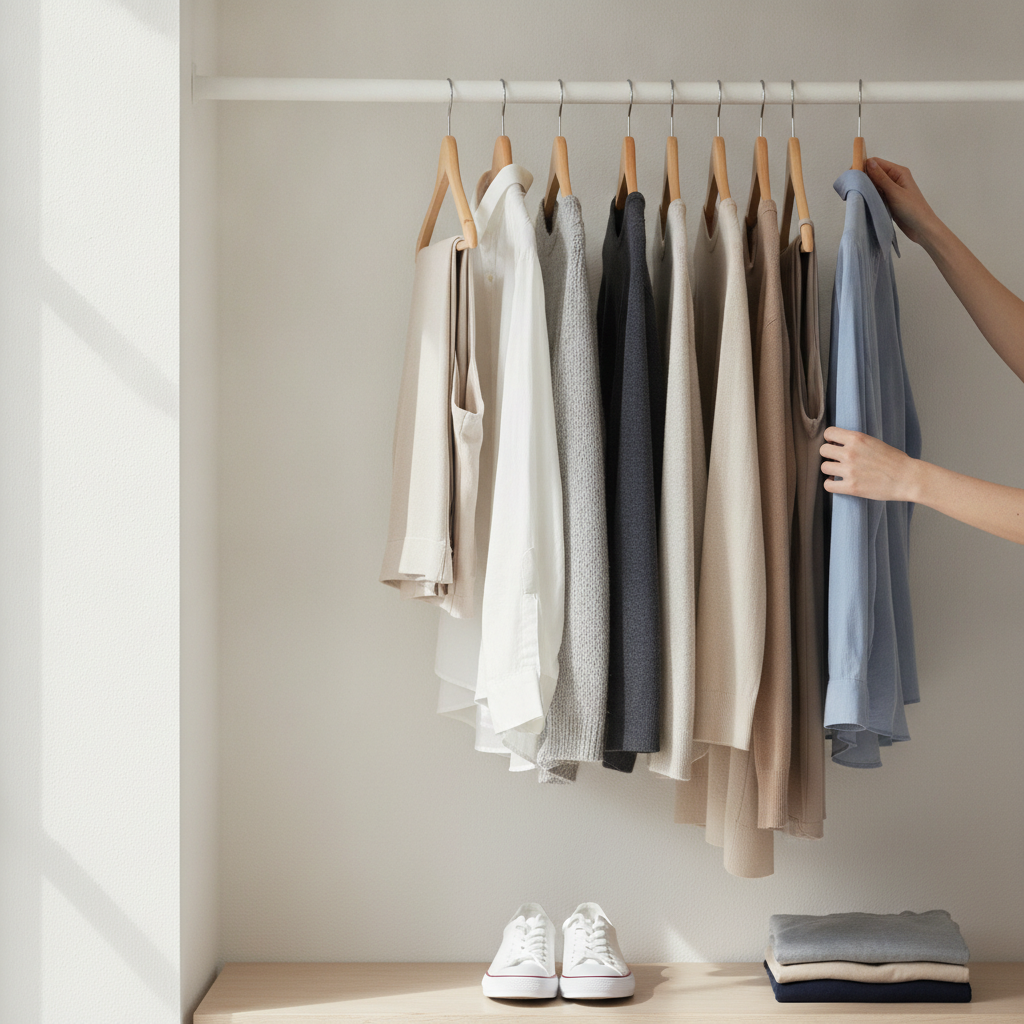
The clothes a person owns have always said something about how they live — but what rarely gets discussed is how much those clothes quietly demand in return. Every morning, before a single word is spoken or a single task is attempted, the mind is already at work sorting, comparing, and choosing. It's a form of labor so habitual it registers as nothing, yet it draws from the same cognitive reserves that will be needed for everything else that follows. The wardrobe, it turns out, is not a neutral space.
Decision Fatigue and the Morning Drain
Cognitive scientists have long recognized a phenomenon sometimes called *decision fatigue* — the way that repeated choices, even small ones, gradually erode a person's capacity for clear judgment as the day progresses. The morning is theoretically the richest time for mental energy, which makes it particularly costly to spend that energy deciding between a grey blazer and a navy one before breakfast. A cluttered wardrobe doesn't just make dressing slower; it introduces a low-grade friction that accumulates quietly, setting a tone of mild overwhelm before the day has properly begun. Reducing the number of choices available at that hour is one of the more elegant ways to protect mental clarity — not through discipline, but through deliberate limitation.
This is part of what has drawn so many people toward the concept of a *capsule wardrobe* — a curated collection of versatile, well-chosen pieces that work together without requiring elaborate mental sorting. The idea gained traction in fashion circles during the 1970s, popularized by London boutique owner Susie Faux, and has since become a touchstone in minimalist lifestyle culture. The appeal isn't purely aesthetic. It's functional in a way that extends well beyond how someone looks when they walk out the door.
The Psychology of Reduced Choice
There's a useful distinction between having options and having too many options. Choice, in moderate quantities, feels like freedom. But past a certain threshold, it begins to feel more like obligation — an endless series of micro-negotiations with one's own preferences, moods, and self-image. A wardrobe stuffed with clothes that are rarely worn creates precisely this dynamic. Each unused item is a silent question: *Why not this one today?* Pared down to a smaller, more intentional selection, those questions disappear. The mind doesn't have to work as hard to arrive at an answer it feels confident about.
People who've adopted more minimal approaches to dressing often describe a sense of relief that they didn't anticipate — not just about getting dressed, but about the general atmosphere of their mornings. When the first decision of the day is simple and settled, subsequent decisions tend to feel more manageable too. There's a kind of psychological momentum at work: clarity tends to compound, just as clutter does.
What Fewer Clothes Actually Looks Like in Practice
A workable minimal wardrobe isn't defined by a specific number, though advocates often suggest somewhere between thirty and forty items for a complete seasonal rotation. Brands like Everlane and Cuyana have built entire business models around the idea of buying fewer, better things — pieces designed to outlast trends and integrate easily with one another. The goal isn't austerity so much as coherence: a collection where nearly everything pairs with nearly everything else, eliminating the combinatorial problem that makes large wardrobes so cognitively taxing.
In neighborhoods like Brooklyn's Cobble Hill or London's Marylebone, where secondhand and slow-fashion boutiques have flourished, the shift toward considered purchasing is visible in how people shop — more deliberately, less impulsively, with a clearer sense of what already exists at home and what would genuinely add to it. Apps like Stylebook allow users to catalog their clothing and track what actually gets worn, often revealing that a fraction of what hangs in the closet accounts for the vast majority of daily choices. That data alone tends to prompt a reassessment.
The Quieter Benefits of a Simplified Wardrobe
There are effects that radiate outward from the wardrobe into other areas of daily life. When the morning routine becomes less effortful, there's a greater likelihood of protecting other routines — exercise, a calm breakfast, a few minutes of reading — that are often the first things sacrificed when time or mental energy runs short. The relationship between environmental order and internal order is well-established: physical simplification tends to reduce background anxiety in ways that are disproportionate to the scale of the change.
Laundry becomes less burdensome. Storage feels more generous. The act of getting dressed shifts from a minor ordeal into something almost meditative — a brief, unhurried ritual rather than a scramble. These are modest-sounding gains, but they accumulate across hundreds of mornings into something meaningfully different about the texture of daily life.
Dressing with Intention
If you've been considering a wardrobe edit, the most useful starting point isn't addition — it's honest subtraction. Go through what's there and ask not whether something might be worn someday, but whether it's actually been worn in the past year and whether it genuinely fits the life being lived now, not the life that was imagined at the time of purchase. What remains after that process tends to be a wardrobe that requires very little from you each morning. The decision is almost made before you open the drawer.
This is the quiet promise of owning less: not deprivation, but a return of attention. The morning belongs to you again — not to the question of what to wear.
The clothes a person owns have always said something about how they live. But the more considered insight is simpler: how much a person owns shapes how freely they can begin each day. A wardrobe that asks little of the mind first thing in the morning gives something back that no amount of additional clothing ever could — a small, reliable pocket of ease in the hours when ease matters most.