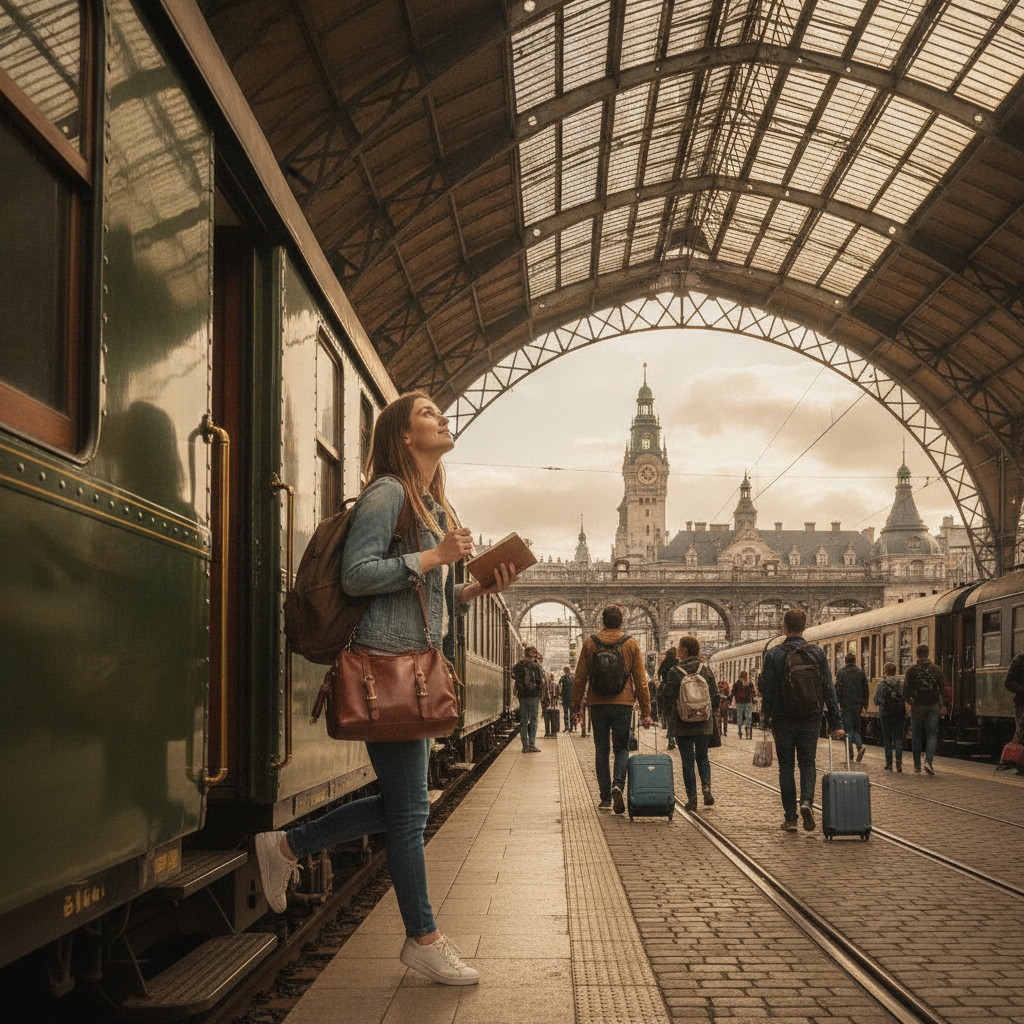
There is a particular kind of disorientation that comes with stepping out of an airport into a city you've never visited before. The terminal exists nowhere — it could be the edge of any metropolitan area on earth, a sealed environment of identical signage, recycled air, and the same duty-free shops repeated across continents. The traveler who lands by plane arrives dropped into a place rather than delivered to it, and that distinction, subtle as it sounds, shapes everything that follows in the first hours of a trip.
The Journey as a Form of Introduction
Train travel offers something the plane fundamentally cannot: a gradual approach. As a train moves from countryside into city, the built environment assembles itself in real time — industrial outskirts giving way to mid-century apartment blocks, rooftops accumulating density, church spires or water towers appearing on the horizon before the station itself comes into view. This is how cities actually work, layer by layer from periphery to center, and the rail traveler absorbs that geography without consciously trying. By the time the train pulls into Roma Termini or Amsterdam Centraal, the passenger has already developed a rough mental map, a felt sense of where the city sits in the world and how its neighborhoods have been stitched together.
This process has a name in urban theory: legibility, the quality that makes a city readable and navigable to a newcomer. Planners talk about legibility in terms of landmarks, pathways, and edges — the cognitive anchors that let people build internal maps. Train arrival tends to activate this process naturally, while air travel suspends it entirely until the moment a taxi deposits someone at a hotel entrance. The airport traveler begins their orientation from a fixed point, radiating outward; the train traveler arrives already oriented.
The Station as a True Center
Most historic train stations were built at the geographic and civic heart of their cities, a legacy of nineteenth-century urban planning that still structures how those places feel today. Gare du Nord in Paris, Zürich Hauptbahnhof, and Kyoto Station are not merely transit hubs — they are genuine thresholds between travel and arrival, places that open directly onto the city's commercial and cultural life. Walking out of a central station, a traveler steps into a neighborhood, not a concourse. Streets fan out in recognizable directions. Markets, cafés, and tram stops appear within a few minutes on foot.
This immediacy is not trivial. The first thirty minutes in a new city set a kind of perceptual tone that persists for days. When those minutes are spent negotiating airport rail links or sitting in a taxi watching motorway barriers scroll past, the city remains abstract for longer. When they're spent walking from a grand station into a square busy with morning commuters, something else happens — the place becomes concrete almost instantly, populated with real rhythms rather than tourist projections.
Arrival Fatigue and Why It Matters Less on the Train
Flying is exhausting in ways that extend beyond the obvious. Pressure changes, recycled cabin air, the sustained low-grade stress of security theater, and the extended passivity of sitting in a pressurized tube all accumulate into what frequent travelers sometimes call arrival fatigue — that dulled, slightly dissociated state that makes the first evening in a new place feel squandered. The body has been transported while the mind has been mostly switched off, and it takes time to reconnect the two.
Train journeys work differently on the nervous system. The traveler remains at ground level, in natural light, with the ability to move, eat a proper meal in a dining car, or simply watch the world pass at a speed the brain can actually process. European intercity services like Eurostar and Frecciarossa, or Japan's Shinkansen network, cover major distances in times that compete seriously with flying once airport procedures are factored in — and arrive passengers who feel present rather than processed. That psychological readiness makes an enormous difference in how quickly someone can start genuinely inhabiting a place rather than merely visiting it.
Reading a Place from the Ground Up
There's a French concept, *flânerie*, that describes the practice of wandering a city with unhurried, open attention — observing street life, architecture, and small details without an agenda. The flâneur doesn't consult a highlights list; they let the city reveal itself through accumulated impressions. Train arrival, more than any other mode, puts the traveler in the right frame of mind for this kind of engagement. The approach through the outskirts has already primed the eye. The walk from the station continues the process. By the time a traveler reaches their accommodation, they've already gathered dozens of small observations — a recurring architectural style, the sound of a particular language dialect, the way locals cross streets or carry their groceries — that no airport transfer could provide.
This accumulated texture is what separates travel that feels genuinely exploratory from travel that feels like moving between managed experiences. Cities reward those who meet them at ground level, and the train, almost by definition, is a ground-level proposition.
Settling In with Intention
When you arrive by rail, the orientation work has already begun before you reach your accommodation. Use that momentum rather than retreating to a screen to plan the next move. Walk at least part of the way from the station if the distance allows. Notice which direction faces the light at that hour, where the density of pedestrians thins, what smells and sounds change as you move through blocks. This kind of deliberate arrival practice — call it conscious landing — tends to compress the adjustment period that most travelers experience in an unfamiliar city. Within a few hours rather than a day or two, the place starts to feel like somewhere you're inhabiting rather than passing through.
The traveler who stepped out of the airport into that sealed, placeless concourse will eventually find their footing in the city too, of course. But something is lost in those early hours of transit abstraction — a chance to meet the place on its own terms, from the edges inward, the way cities have always been meant to be approached. The train doesn't just change the journey. It changes what kind of arrival becomes possible.