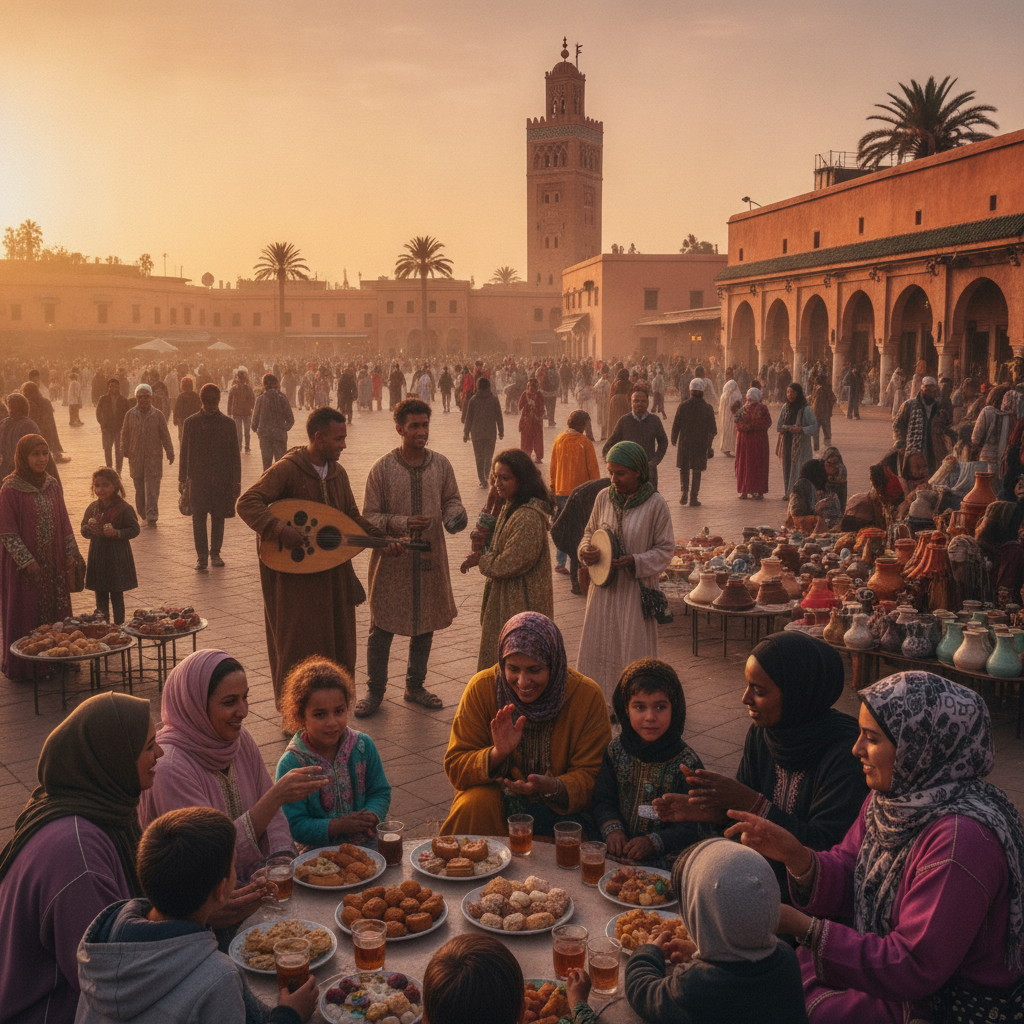
There is a version of Morocco that most first-time visitors never encounter — not because it's hidden, but because they arrive at the wrong moment. Peak winter draws a steady stream of travelers to Marrakech and Fès, drawn by mild temperatures and the appeal of escaping grey northern skies. What they find is a country that, while genuinely beautiful, is performing a version of itself calibrated for outsiders: busy medinas full of tour groups, inflated prices at popular riads, and a daily rhythm shaped more by tourism than by the lived culture underneath it. Arriving just after Ramadan ends, by contrast, means stepping into a country exhaling — one that has just moved through its most inward, communal season and is ready to open outward again.
The Texture of Post-Ramadan Morocco
Ramadan restructures Moroccan daily life completely. Businesses operate on compressed hours, street food vendors disappear from their usual posts during daylight, and the social energy of the country shifts inward toward family and mosque. Eid al-Fitr, the celebration that marks the end of the fast, releases all of that contained energy in one concentrated burst of hospitality, music, and communal eating. For the weeks that follow, Morocco sits in a particular kind of open mood — festive residue still in the air, families lingering longer in public spaces, and a genuine warmth toward visitors that isn't driven by commercial transaction. Travelers who time their arrival to land in this window often describe it as the most socially generous experience they've had anywhere in the region.
The practical consequences are equally meaningful. Restaurants that closed early or didn't serve during daylight are back to full operation, often with rotating menus that reflect seasonal abundance rather than the compressed offerings of Ramadan service. Street food culture — one of Morocco's most rewarding travel experiences — returns to full force in the evenings, with vendors setting up in squares and alleyways that were quiet for weeks. In Fès, the area around Bab Bou Jeloud fills again with activity, and the food stalls that ring the main square in Marrakech's Djemaa el-Fna reassemble into their full, chaotic, magnificent form. For a first-time visitor, this is the version of Morocco that stays with you.
Navigating the Timing Without Overcomplicating It
Ramadan follows the Islamic lunar calendar, which means its dates shift by roughly ten days each year relative to the Gregorian calendar. In practical terms, this means post-Ramadan Morocco can fall in spring, early summer, or even autumn depending on the year, and planning requires some calendar awareness rather than a fixed seasonal assumption. Apps like Hijri Calendar and Time Zone Pro make it straightforward to track the expected Eid date well in advance, and travel planning platforms like Airbnb and Google Flights allow enough flexibility to build an itinerary around a floating target once the approximate window is confirmed. The effort is modest, and the payoff in terms of cultural access is disproportionately large.
What the Post-Ramadan Window Offers That Winter Cannot
Winter in Morocco — roughly November through February — has genuine appeal. The Atlas Mountains carry snow, the southern desert is bearable rather than punishing, and cities like Essaouira take on a moody, windswept quality that suits a certain kind of traveler. But winter also coincides with the highest concentration of European visitors, which means pricing at popular accommodations trends upward, guides in medina markets are focused on volume, and the spontaneous interactions that define meaningful travel become harder to find. Post-Ramadan Morocco, by contrast, often falls outside the heaviest tourist traffic, which means guesthouses are more available, negotiation in souks feels less transactional, and the people you meet are simply more present.
The social openness of the post-Eid period is worth understanding on its own terms. Moroccan hospitality is not a performance — it's a cultural value with deep roots — but it expresses itself most naturally when the host community isn't exhausted or distracted. After weeks of fasting and the intensity of Eid celebrations, there's a particular kind of social generosity that emerges: neighbors lingering in doorways, families in outdoor cafés for hours, and a general willingness to extend the festive spirit to newcomers. A first-time visitor who arrives in this window will likely be invited to share tea or sweets in a way that feels genuinely unrehearsed rather than commercially motivated.
Practical Considerations for the Trip Itself
Post-Ramadan temperatures vary widely depending on the year's calendar position, so packing requires more attention to local forecasts than to general seasonal advice. When the window falls in late spring, cities like Marrakech can already be warm by midday, making morning and evening the best times for medina exploration. Essaouira, with its Atlantic winds, remains comfortable almost regardless of when you visit, and it offers a useful base for anyone who wants to escape the intensity of the larger imperial cities. Accommodation in residential neighborhoods — using platforms like Booking.com to filter away from the main tourist corridors — puts you closer to the daily rhythms that define post-Ramadan life rather than the commercial layer built over them.
Budgeting is also more forgiving in this window. Without the pressure of peak-season competition for rooms, riads and guesthouses in the medinas of Fès and Chefchaouen tend to be more openly priced, and the return of full restaurant service means you're less dependent on tourist-facing options. Bringing a modest daily cash allocation in dirhams keeps spending intentional and naturally anchors you to the street-level economy where the most authentic experiences happen.
The Longer Case for Seasonal Intelligence
Travel has a tendency to reward people who think one step beyond the obvious. The instinct to visit Morocco in winter is understandable — the logic of mild weather and manageable crowds seems sound from a distance. But the travelers who come home with something more than photographs are usually the ones who asked a different question: not when is it most comfortable, but when is the country most itself. Post-Ramadan Morocco answers that question with unusual clarity. The culture is mid-exhale, the hospitality is genuine rather than transactional, and the daily life that most visitors miss entirely is fully visible and accessible. That is the Morocco worth planning toward — and with a little calendar awareness and a flexible booking window, it's well within reach.