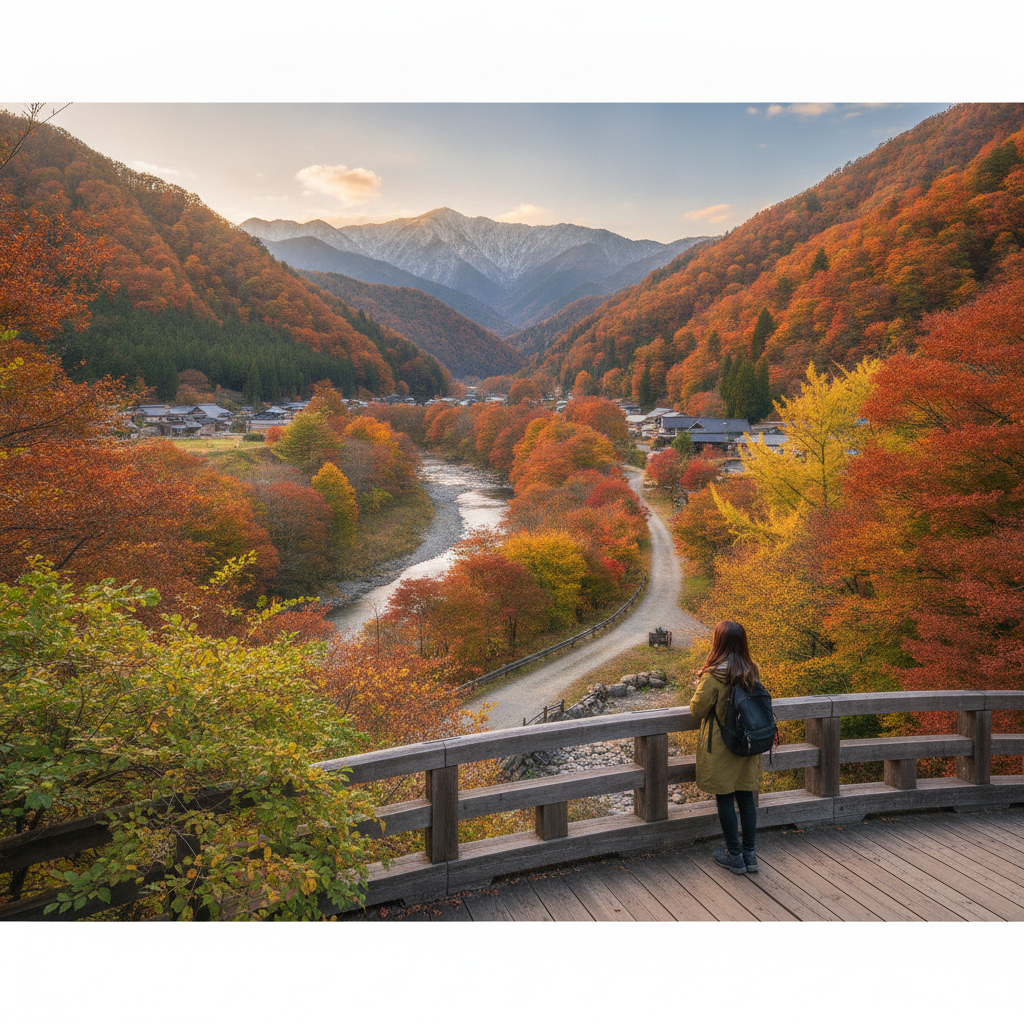
Autumn in Japan is one of those travel experiences that arrives with enormous expectation. You book flights months in advance, lock in accommodation in Kyoto or Tokyo, and circle a date on the calendar based on what a travel blog once described as peak season. Then you land, and the maples are either still green or already spent, and the journey you imagined — those burnished hillsides and temple courtyards glowing amber — belongs to someone else's itinerary by about ten days. This is the most common and quietly deflating miscalculation in Japanese autumn travel, and it happens almost entirely because of one overlooked variable: Japan's foliage doesn't follow a single national schedule.
The Geography Behind the Color
Japan stretches across a significant range of latitudes, and its terrain shifts dramatically between mountain interior and coastal plain, between the highlands of Hokkaido in the north and the subtropical south. Autumn color follows this geography in a slow, descending wave that typically begins in Hokkaido in late September and doesn't reach its southern conclusion in places like Hiroshima's Miyajima island or the Kyushu highlands until late November or even early December. Within any single region, the difference between a mountain village and a city center can be nearly two weeks. Nikko's cedar-lined avenues and its surrounding mountainside shrines, for instance, tend to peak well before the city of Tokyo shows much change at all. Planning as though Japan has one unified autumn is the root error — and correcting it requires building the itinerary around the forecast rather than the other way around.
Reading the Forecast Before You Route
Several platforms track Japan's koyo, or autumn foliage, in real time. The Japan Meteorological Corporation releases annual foliage predictions that regional tourism boards amplify, and apps like Tenki.jp carry updated color maps that show current and projected peak windows across prefectures. Jorudan, widely used for transit planning, can help you sequence routes once you know which regions are approaching their peak. What these tools allow you to do is plan a trip that moves with the season rather than sitting in one place and hoping the timing aligns. A traveler who books accommodation with reasonable flexibility — perhaps two or three anchor points rather than a rigid nightly sequence — can adjust their movement based on where the color is strongest in any given week.
Why Fixed Dates Work Against You
The standard approach to booking Japan travel involves locking in everything from flights to train passes to hotel rooms many months early, which makes sense given how quickly accommodation fills during koyo season. The problem is that this rigidity removes all ability to respond to the actual foliage conditions. A traveler committed to spending days seven through ten in Kyoto has no practical way to extend their stay in the Japanese Alps if Kamikochi is at its most extraordinary exactly then. Building at least one or two nights of buffer into each leg of the trip — or choosing accommodation with more lenient cancellation windows — restores the flexibility that weather-dependent travel genuinely requires.
How a Forecast-Led Itinerary Actually Takes Shape
The most effective approach begins with identifying two or three high-priority foliage regions rather than a single city, then using the seasonal forecast to determine the sequence and timing of your movement between them. Hokkaido's Lake Towada area and the highlands around Nikko tend to peak earlier, making them natural starting points in mid-to-late October. The Kyoto basin and surrounding Arashiyama district typically reach their most photogenic state in mid-to-late November, and the Hiroshima region often trails by another week or so. A journey that flows roughly north to south across these windows doesn't just improve your chances of catching peak color in each location — it also produces a trip whose physical shape emerges organically from the landscape rather than from a template.
When the Detour Becomes the Destination
What travelers consistently report about forecast-led Japan trips is that the unplanned adjustments become the defining memories. A detour into a small mountain town in Nagano Prefecture because the forecast suggested color was arriving three days early there — rather than following the original plan to stay another night in a city — often produces the kind of encounter with rural Japan that a fixed itinerary never allows. Local festivals, roadside stalls selling roasted chestnuts, quiet ryokan innkeepers with no other guests that week: these experiences cluster in the places that the forecast pulls you toward rather than the places that guidebooks point you at. The journey you end up taking rarely resembles the one you planned, and that divergence is the point.
Tools Worth Checking Before You Finalize Anything
Beyond Tenki.jp and the Japan Meteorological Corporation's seasonal outlook, the website Autumn Leaves Japan aggregates crowd-sourced reports from travelers and locals, giving a street-level sense of current conditions that satellite data and meteorological models can't always capture. Cross-referencing these sources in the two to three weeks before departure — and again in the first days of your trip — gives a genuinely useful picture of where to position yourself next. None of this requires dismantling a carefully planned itinerary entirely; it simply means holding the plan loosely enough that a well-timed adjustment is possible when the forecast clearly points in a different direction.
There's a particular quality of satisfaction that comes from arriving somewhere at exactly the right moment — not because you guessed correctly, but because you were paying attention to signals that were always available. Japan's autumn foliage rewards exactly this kind of attentiveness. The traveler who builds their trip around a fixed calendar date is chasing a version of Japan that may or may not materialize that week. The traveler who watches the forecast, keeps a little room in the plan, and moves when the color moves tends to find something closer to what they were looking for — and usually something they weren't expecting at all. That tension between preparation and flexibility is, in many ways, the whole art of traveling well.