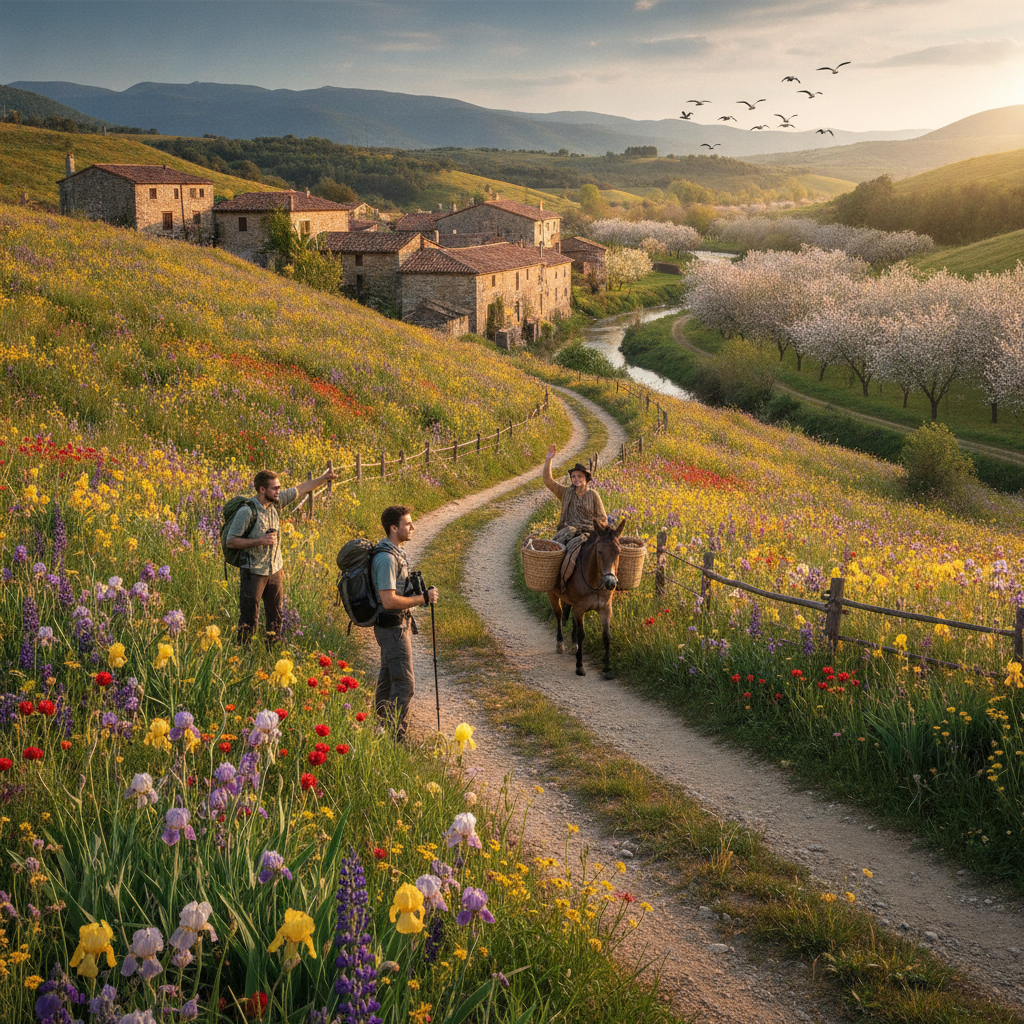
Coastal destinations own the spring travel imagination in a way that inland regions rarely do. The imagery is seductive and familiar — harbour light, ferry schedules, whitewashed walls catching the first warm sun — and travel platforms serve it back to you endlessly because it performs well. But there is another kind of spring unfolding several hours from any shoreline, in the orchard valleys and meadow roads of rural inland regions, and it operates on a calendar that most travellers never think to consult. Those who do tend to return with something harder to name than a highlight reel: a sense of having witnessed a place in the middle of its own logic, rather than at the edge of someone else's itinerary.
When the Bloom Calendar Becomes the Itinerary
Reading the Land Before You Book
The bloom calendar of an inland agricultural region is not a tourist document — it's a working record of when cherry orchards peak, when wildflower meadows reach full colour, when almond groves drop their petals and the air carries a particular sweetness that lasts only days. Consulting one before booking a trip reframes the entire planning process. Instead of choosing a destination and hoping the season cooperates, you let the season determine the destination. Apps like Gaia GPS and iNaturalist carry seasonally updated observations from local contributors, making it possible to cross-reference bloom timing in specific valleys with reasonable accuracy before committing to dates.
Inland Timing Runs on Different Logic
Unlike coastal spring, which arrives with a kind of predictable Mediterranean rhythm, inland bloom seasons are shaped by elevation, soil type, and microclimate in ways that can shift the peak window by two or three weeks from one valley to the next. The Extremadura region of western Spain, for example, sees its stork migrations and wildflower eruptions in a window that rarely overlaps with when the coast feels ready for visitors. The Dordogne in southwestern France enters cherry blossom season while many coastal towns are still posting "closed for winter" signs. These gaps are not inconveniences — they are precisely where the experience lives.
The Practical Case for Rural Inland Timing
Accommodation and Crowds Operate Differently
Rural inland regions during spring bloom are not empty — local festivals, agricultural fairs, and walking groups often fill small guesthouses weeks in advance — but they are genuinely less pressured than coastal counterparts. Booking through platforms like Airbnb or direct with local chambres d'hôtes reveals accommodation options that sit inside working farms or century-old stone farmhouses, places where the owner knows what week the poppies typically open in the field behind the property. That kind of local knowledge is not available at a coastal resort, and it changes every conversation you have about where to go and when to go there.
The Budget Behaves Better Inland
Spring at the coast carries a pricing logic tied to the school calendar and the beach season's approach, which means that even a trip in April to a popular coastal destination can reflect near-peak rates at popular accommodations and restaurants. Inland rural regions — even beautiful ones — price according to a quieter demand curve. The value is not just financial; it extends to the quality of attention you receive at a restaurant that serves twenty covers a night rather than two hundred, or the ease of lingering at a viewpoint without needing to wait for a clear shot of the horizon.
What the Encounter Produces That the Coast Cannot
Agriculture as Living Background
One of the underrated gifts of timing a trip around an inland bloom calendar is that the agricultural cycle gives the visit a structure that coastal travel rarely has. Orchards being worked by hand, fruit pickers moving through rows in early morning light, local markets stacked with whatever happened to ripen that week — these are not performances staged for visitors, they are operations running on their own schedule that you happen to be present for. The Wachau valley in Austria during its apricot blossom period is one of the more well-known examples, but even lesser-documented regions in Hungary's Tokaj hills or Spain's Sierra de Francia offer versions of this layered encounter.
Wildlife and Birdlife Follow the Same Window
Bloom calendars and wildlife activity calendars are more closely linked than most travellers realise. The insects that emerge with the flowers draw the birds that draw the birders, and all of it happens in a concentrated window that passes quickly. Tracking apps like Merlin Bird ID from the Cornell Lab of Ornithology allow you to identify what species are active in a specific inland region during a specific month, which adds another layer of intentionality to planning. Travelling when the hoopoes arrive in the Spanish interior, or when the white storks return to their nests in old village church towers, positions you inside an ecological moment that the coastal visitor simply misses.
Translating This Into an Actual Plan
Building the Framework Around a Two-Week Window
Planning effectively around an inland bloom calendar means accepting a degree of timing flexibility that coast-focused trips rarely require. The bloom window is real but not guaranteed to the exact week, which means building an itinerary with some geographic range — two or three valleys within a region rather than a fixed single base — creates the resilience to follow what's actually happening on the ground. A practical approach is to identify the typical bloom peak for a region, book accommodation for a two-week window centred on that midpoint, and then use the first two days of the trip to ask locals and check iNaturalist observations before committing to a specific direction.
The First Morning Sets the Whole Register
Arriving in a rural inland region during bloom season and spending the first morning without a fixed plan — walking a road that the accommodation host suggested, stopping where the light or the smell suggests stopping — produces a kind of orientation that guidebook itineraries actively work against. The impulse to optimise every hour is understandable, but inland spring is genuinely better experienced as a calibration than a schedule. The encounters that tend to define these trips — a shepherd pointing you toward a pasture where the orchids are still standing, a farmhouse owner offering a glass of something local before you've even checked in properly — arrive in the unstructured moments, not the planned ones.
There is something quietly radical about letting a bloom calendar rather than a beach forecast determine where you go in spring. The traveller who consults iNaturalist before a booking platform, who chooses a valley in Extremadura or the hills above the Dordogne over another week on a familiar coast, is not making a contrarian choice so much as a precise one. The landscapes and encounters waiting in rural inland regions during their brief seasonal peak do not appear in most guidebooks because they resist the kind of photography and packaging that guidebooks depend on. They are experiential in a way that requires presence rather than planning — which makes the small amount of planning required to arrive at the right time feel like exactly the right investment to make.