There is a particular kind of travel disappointment that arrives only after you've already booked — the slow realization that the image you were chasing and the reality waiting for you are separated by crowds, coach buses, and a gift shop. Spring in the Netherlands is one of the world's most photographed seasonal moments, and yet the majority of visitors who come for the flowers spend most of their time in a city that, for all its genuine beauty, was never designed around the bloom. Those who reroute their plans toward the growing regions themselves tend to come home with something richer: not just better photographs, but a quieter, more grounded experience of what the season actually feels like from the inside.
The Geography of the Bloom Matters More Than You Think
The tulip fields that define the Dutch spring are concentrated in a band of coastal polderland running roughly between Haarlem and Den Helder, with the Bollenstreek — the Bulb District — sitting at the heart of it. This is flat, open agricultural country where the fields run in solid-color stripes from the roadside to the horizon, and where the light behaves differently than it does in any city. Amsterdam sits on the edge of this region, close enough to feel accessible but positioned in a way that most visitors never make the full transition from urban tourism to field-level immersion. Understanding this geography before you plan is what separates a trip built around the bloom from one that merely glances at it.
When to Time Your Visit
The tulip season across the Bollenstreek generally runs from mid-March through early May, with peak color shifting depending on variety and weather in any given year. Hyacinths tend to arrive first, filling the air with a scent that's almost disorienting in its intensity. Mid-April is traditionally when the color is most saturated and most varied across species. The app Buiksloterweg Bloemen and the Keukenhof Gardens' own website both publish field condition updates that are genuinely useful for calibrating your arrival window. Getting the timing right — even within a week — changes the visual experience entirely, and building some flexibility into your itinerary is one of the more practical decisions you can make.
Keukenhof as a Gateway, Not a Destination
Most spring visitors to the Netherlands treat Keukenhof Gardens near Lisse as their primary tulip experience and consider the trip complete. Keukenhof is genuinely beautiful — it's one of the largest flower gardens in the world, and it manages its plantings with extraordinary precision. But it's also extremely popular, and visiting it as your sole floral experience means missing the agricultural reality that surrounds it. The smarter approach is to use Keukenhof as an orientation point on your first or second day, then spend the remainder of your time cycling the open roads between Lisse, Hillegom, and Noordwijkerhout, where the working farms stretch uninterrupted and the foot traffic drops to almost nothing.
Cycling as the Correct Mode of Travel Here
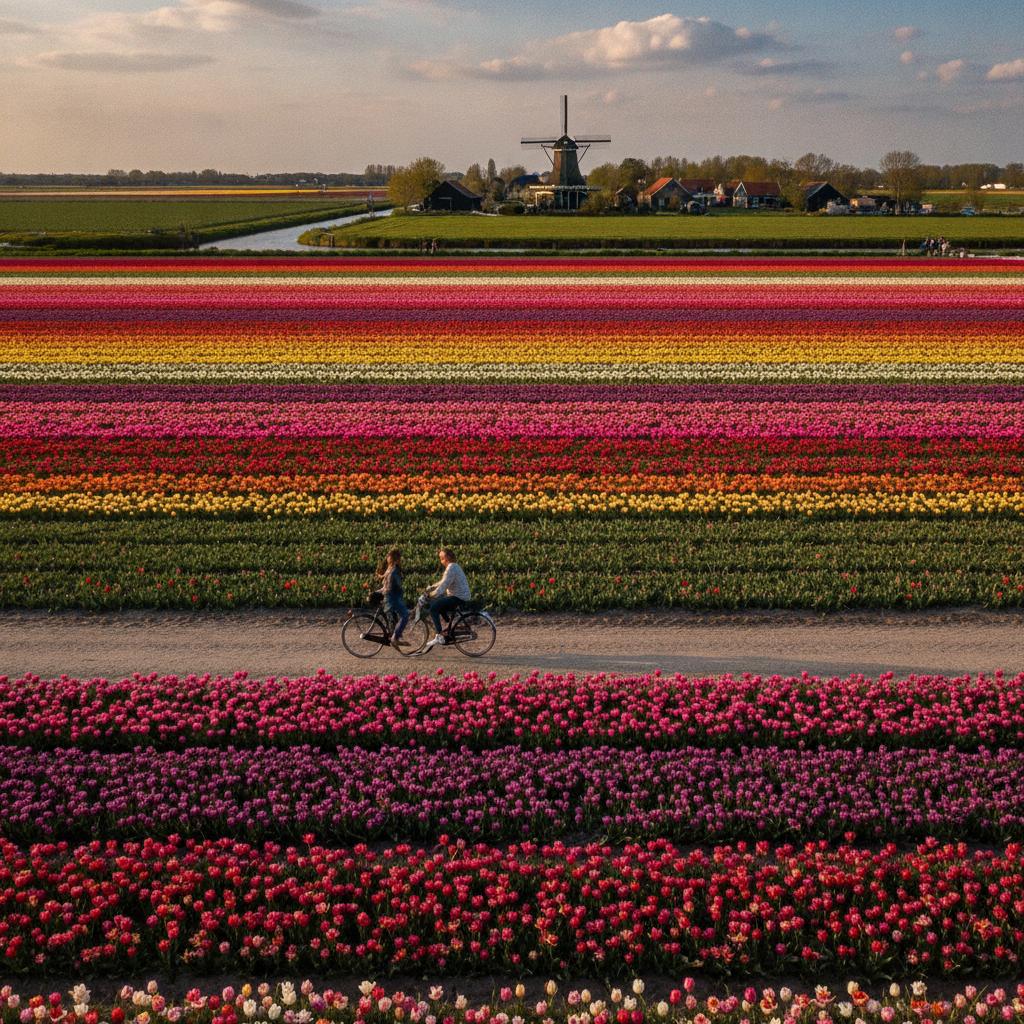
The Bollenstreek was effectively designed for cycling, and this is not a romantic exaggeration. The bike paths run alongside the fields with almost no elevation change, and routes like the Bollenstreek Route — a well-marked loop of roughly 30 kilometers — pass through color blocks that shift every few hundred meters. Renting bikes in Haarlem or picking up a route through the NS Fiets bike rental service at regional train stations keeps the logistics simple and puts you at eye level with the fields rather than above them. What you encounter at 15 kilometers per hour is fundamentally different from what you see through a bus window, and that difference is the entire point of choosing this itinerary over a city-centered one.
Staying in the Region Changes the Morning Entirely
One of the most underappreciated decisions a traveler can make in the Bollenstreek is where to sleep. Staying in Haarlem rather than Amsterdam already shifts the experience considerably — Haarlem is a smaller, calmer city with its own medieval center and direct rail access to the fields. But staying in one of the small villages within the Bollenstreek itself, in a farmhouse rental or a locally run guesthouse, produces something different again. Early morning in the fields, before the day-trippers arrive from Amsterdam, has a quality of light and quiet that no afternoon visit can replicate. The mist sits low across the polder, the colors are at their most saturated before full sun, and for an hour or two the paths belong almost entirely to you.
Finding Accommodation Outside the Obvious Choices
Platforms like Booking.com and Airbnb both carry listings in villages like Anna Paulowna, Breezand, and Julianadorp — smaller communities further north in the bulb-growing region that see a fraction of the visitors drawn to the areas closer to Amsterdam. These places tend to have lower nightly rates, more genuine contact with local farming life, and a slower pace that suits a spring itinerary built around observation rather than activity. Spending three or four nights in a single base here, rather than splitting time between multiple cities, allows the rhythm of the season to become genuinely familiar rather than something glimpsed between transit connections.
The Visual Rewards of an Agricultural Focus
What the tulip farm regions offer that no urban context can replicate is scale — not the intimate, curated scale of a garden, but the raw, agricultural scale of fields that seem to continue past the point where the eye can follow them. The color relationships between adjacent rows, the contrast between the blooms and the flat gray sky that often sits above the polder in April, the way a road disappears into a stripe of red or yellow at the vanishing point — these are visual experiences that travel photography has been chasing for decades, and they're available to anyone willing to leave the city behind. Google Maps' satellite view, switched to the spring months, gives a reasonable preview of what the region looks like at peak — but nothing quite prepares you for it at ground level.
Travelers who build their Dutch spring around the farm regions rather than the capital tend to return with a different kind of memory — not the crowded canal selfie or the queue outside a museum, but the specific quality of a Tuesday morning in the Bollenstreek when the wind moves across an open field and the color shifts in waves. That image stays. The city will always be there, and Amsterdam deserves its own visit on its own terms. But the tulips have a season, and the best version of that season is found not in the city's periphery, but in the flat, brilliant fields where the bulbs have been grown for centuries.