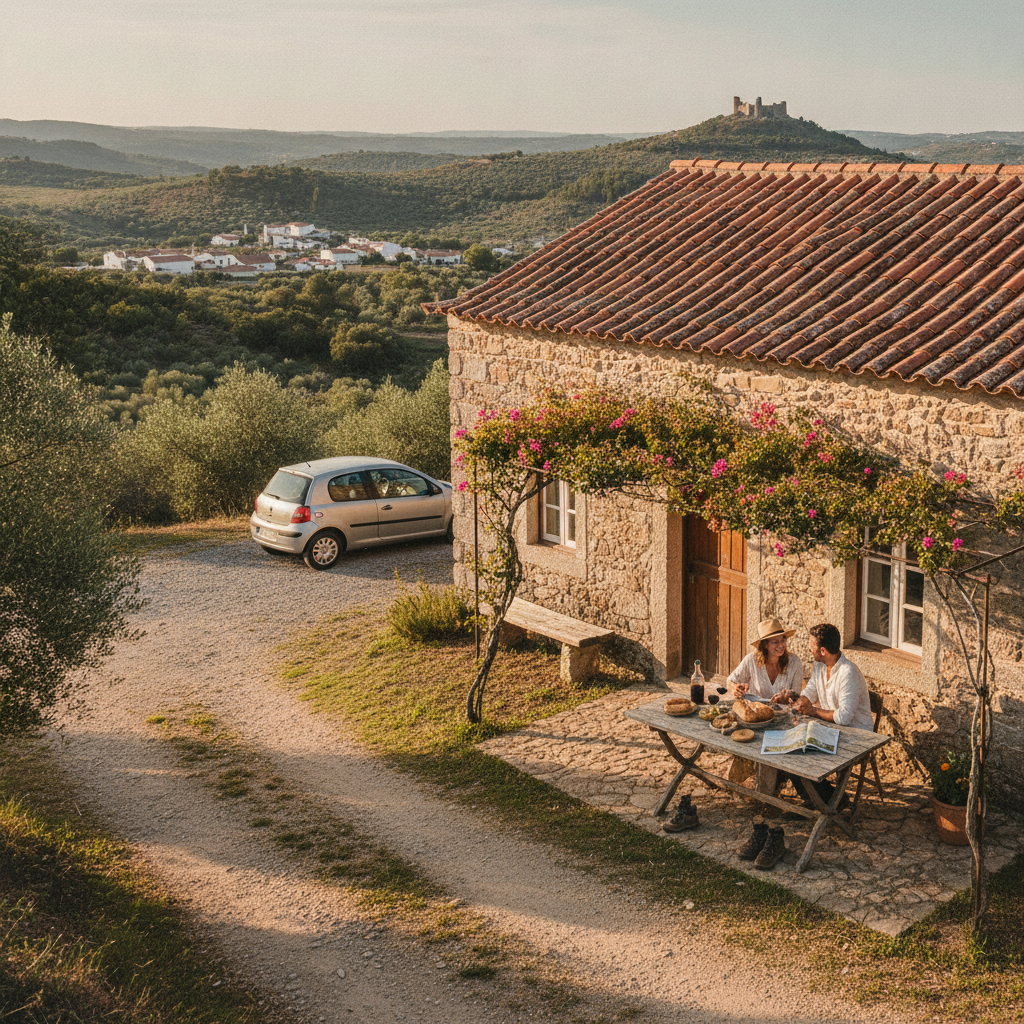
Staying in one place for two weeks costs less than moving every two days — and it gives you something that no amount of sightseeing can manufacture: the feeling that you actually belong somewhere, even briefly.
Most travelers in Portugal default to a multi-city loop. Lisbon, Porto, the Algarve. Each stop two or three nights. It looks efficient on paper, but in practice you spend a surprising portion of each day in transit, checking in, orienting yourself, and never quite settling. Rural Portugal — the Alentejo plains, the villages of the Douro Valley, the slower towns of the Minho region — rewards a completely different approach. When you anchor yourself in one place and move outward from it each day, the economics shift in your favor and the experience deepens in ways that are hard to replicate any other way.
Choose Your Base Town the Way You'd Choose a Home
The choice of base matters more than almost anything else. You're not looking for the most photogenic village or the one with the most amenities — you're looking for a town that has enough going on to hold your interest between day trips but isn't so touristy that it prices itself accordingly. Places like Évora, Estremoz, or the smaller market towns around the Serra da Estrela are worth serious consideration. A quinta rental or a small guesthouse on the edge of a working agricultural village will almost always cost less per night than even a modest hotel in Lisbon, and after the first three days, the owners know your name.
Calculate the Real Cost of Moving Versus Staying
People underestimate how much moving around costs beyond accommodation. Every time you switch base, you're absorbing transport fares, the premium that tourist-area restaurants charge, checked luggage fees if you're hopping between cities by train, and the invisible cost of arriving somewhere unfamiliar and making expensive decisions before you've found your footing. When you're based in one rural spot and taking day trips outward, you control the daily budget far more precisely. Local supermarkets, a morning coffee at the same café, and packed lunches on the road — none of that is available when you're perpetually checking in somewhere new.
Book at Least 12 Nights to Unlock Real Negotiating Power
Long-stay discounts in rural Portugal are genuine and often significant. Owners of small quintas and rural guesthouses outside the main tourist infrastructure have different incentives than urban properties. A two-week stay negotiated directly — bypassing platforms like Booking.com or Airbnb where possible — gives you room to ask for a better nightly rate, a small kitchenette, or simple extras like a packed breakfast. The longer the stay, the more the host treats you as a guest rather than a transaction. That shift in dynamic alone changes the quality of what you learn about the region, because people talk differently to someone who's staying than to someone who's passing through.
Design Your Day Trips Around the Train and Bus Network First
Portugal's Comboios de Portugal rail network connects rural towns to regional hubs more reliably than most visitors expect. From a base in the Alentejo, day trips to Elvas, Beja, or even the Spanish border at Badajoz are straightforward by regional train. From the Douro Valley, the historic Linha do Douro runs along the river to Porto and back. Building your day trips around what the public transport network actually offers — rather than renting a car and adding fuel, insurance, and parking to every excursion — keeps the daily budget predictable and removes a layer of logistical stress that accumulates quietly across a long trip.
Let the Repetition of a Place Do Its Work
The quality of connection you build with a rural Portuguese town is almost entirely a function of time and repetition. The second morning you walk to the same pastelaria and the owner already knows you want a galão with your pastel de nata — that's not a small thing. It's the mechanism through which a place stops being a backdrop and becomes something you carry home. Returning to the same village square each evening, watching how the light changes across the week, noticing who the regulars are at the tabacaria — these are the details that make a trip memorable in a way that a different landmark each day simply cannot produce.
Use Slower Days as Budget Recovery Days
Not every day needs to be a day trip. Two or three days each week spent entirely in your base town — walking, reading, cooking in a kitchenette, wandering without purpose — cost almost nothing and serve a dual function. They reset the budget after a travel-heavy day and they deepen your relationship with the specific place you've chosen. The Alentejo in particular rewards this kind of unhurried presence. The landscape changes slowly across a morning. The silence in the midday heat is its own kind of experience. These aren't wasted days; they're often the ones you remember most clearly.
Track Spending Weekly, Not Daily
A weekly budget review works better than daily tracking when you're traveling slowly from a fixed base. Some days cost almost nothing; a day trip to a UNESCO site with a long lunch costs more. If you're checking your spending every evening, you'll make anxious decisions that don't reflect the actual rhythm of the trip. A weekly check-in — what did I spend, where did the money go, what do I want to adjust — keeps you honest without creating the kind of micro-management that drains the pleasure out of travel. The overall cost of two weeks in rural Portugal, structured this way, tends to come in well below what the same period spent moving between cities would cost.
Build In One Overnight Away From Base
Two weeks in one place works best when you give yourself one deliberate exception. A single night somewhere else — a coastal town on the Alentejo coast like Vila Nova de Milfontes, or a night in Porto if you're based further north — does something useful. It reminds you why you chose the slower approach. After one night in a busier place, the return to your base feels like coming back to somewhere known. That contrast sharpens your appreciation for what you've been building across the whole two weeks: not just a cheaper trip, but a more complete one.
The slow-base model in rural Portugal is increasingly practical as more travelers move away from itinerary-heavy approaches and look for trips that actually rest them. Quinta rentals and rural guesthouses in regions like the Alentejo and Minho are adapting to longer-stay guests, adding kitchenettes, improving Wi-Fi, and offering informal local guiding for day trips. The infrastructure is there. The question is just whether you're willing to trade the checklist for something that takes a little longer to pay off — and pays off considerably more.