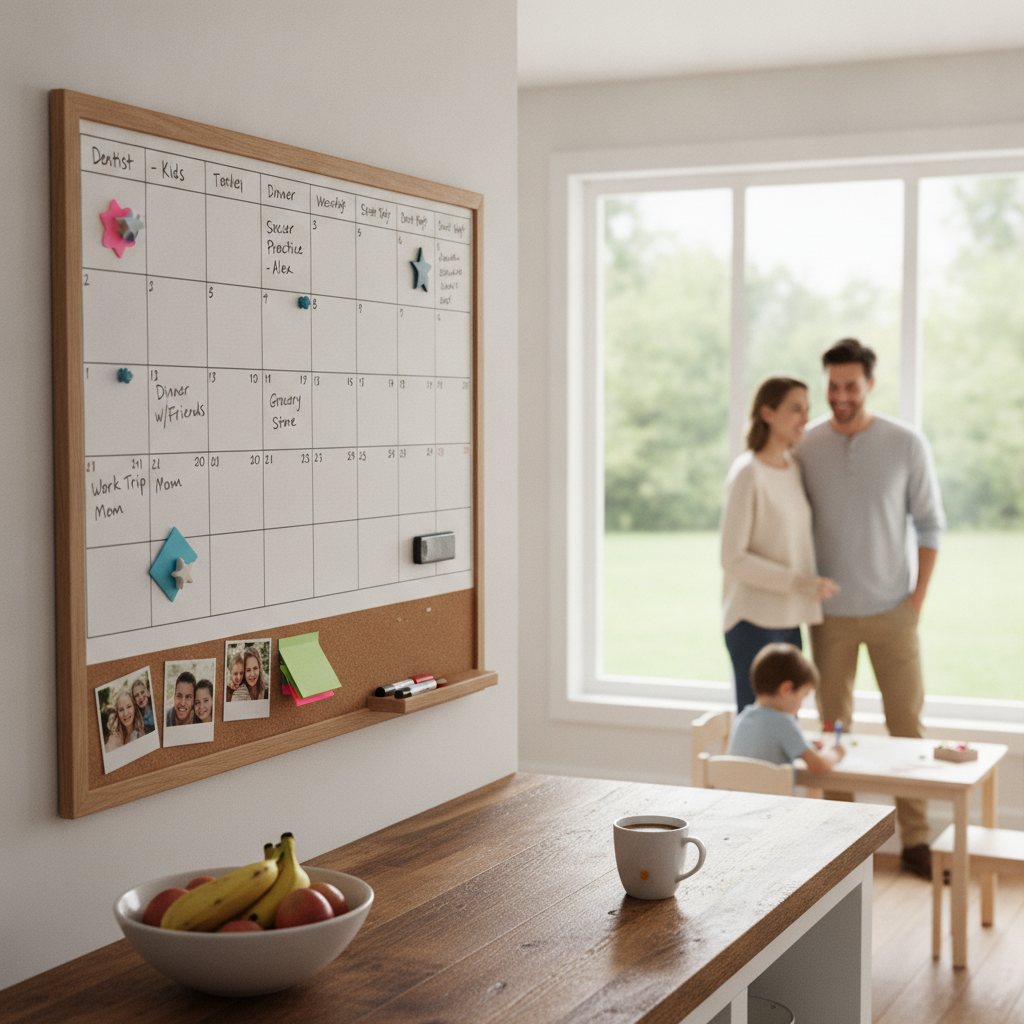
Shared schedules have a way of becoming invisible the moment each person manages their own. One partner tracks commitments in a phone app, the other keeps mental notes, and the kids' activities live somewhere between a school newsletter and a group chat nobody checks consistently. The result isn't chaos exactly — it's a slower kind of friction, a steady accumulation of small miscommunications, double-bookings, and last-minute scrambles that gradually wear down the goodwill in a household.
A single physical calendar, placed somewhere everyone passes daily, interrupts that pattern in a surprisingly direct way. It doesn't require an app, a subscription, or anyone learning a new system. What it does require is a little intentionality about how you set it up and how your household uses it.
Where Should You Actually Put the Calendar?
Placement is the first decision, and it matters more than most people expect. A calendar tucked inside a cupboard door or propped on a desk in one room already belongs to one person. The goal is a genuinely shared space — a kitchen wall near the coffee maker, a hallway nook between the front door and the living area, or the side of a refrigerator that faces the room rather than the wall. Wherever your household naturally converges in the morning or at the end of the day is where the calendar earns its value. Visibility creates the habit, and the habit replaces the need for constant verbal check-ins.
What Format Actually Works for More Than One Person?
A large monthly wall calendar with generous daily boxes — something like those offered by AT-A-GLANCE or Blue Sky — gives every household member enough room to write without crowding. Smaller day-planner formats tend to serve individuals, not groups. If your household runs across multiple people with distinct schedules, look for formats that offer at least a few square inches per day. Some families add a narrow whiteboard strip beside the calendar for floating notes — things like grocery reminders or appointment prep — keeping the calendar itself clean and readable at a glance.
How Do Color Codes Reduce the Need for Explanation?
Assigning each household member a specific pen or marker color is one of the simplest organizational decisions you can make, and its effect on daily communication is disproportionate to the effort. When you can see at a glance that Tuesday is heavy with overlapping commitments — three colors stacked in one box — you understand the tension without anyone having to say it. This visual shorthand makes negotiation feel less like a conversation and more like reading a shared document. Staedtler and Crayola both offer fine-tip markers that write cleanly on calendar paper without bleeding through.
When Should the Household Actually Review the Calendar Together?
A physical calendar doesn't update itself or send reminders, which means it works best when paired with a brief, regular household check-in. Sunday evenings work well for most families — a five to ten minute scan of the coming week where anyone can flag conflicts, claim the car, or note that they'll be home late. This doesn't need to be a formal meeting. Standing in the kitchen while dinner settles is enough. The calendar gives that conversation structure, so it stays focused and short rather than sprawling into something people avoid.
How Does Writing Things Down Change Commitment?
There's something about the physical act of writing an event on a shared calendar that raises its status in a household. A commitment entered in an app remains somewhat private and provisional. A commitment written in your color, in front of the shared space, carries a different weight. Other people can see it, reference it, and plan around it without asking. This shift from private tracking to public record subtly reduces the number of times someone needs to announce or defend their schedule — the calendar speaks for them.
What Belongs on the Calendar and What Doesn't?
Not every detail needs to live there. The shared household calendar works best when it holds logistical information that affects more than one person — work travel, school events, medical appointments, social commitments that involve the house or the car, and deadlines that change the household rhythm. Personal reminders, individual tasks, and private notes belong elsewhere. Keeping the calendar signal-to-noise ratio high ensures that everyone actually reads it instead of skimming past entries that don't concern them. Clutter on a shared calendar produces the same effect as clutter anywhere else: people stop paying attention.
How Does a Physical Calendar Reduce Low-Level Relationship Friction?
A significant portion of household tension doesn't come from genuine disagreement — it comes from information gaps. When one person doesn't know the other has an early meeting, a late pickup, or a friend visiting, small logistical collisions happen that feel larger than they are. A shared physical calendar closes those gaps passively, without requiring anyone to announce themselves or check in repeatedly. Over time, households that use one tend to report fewer of those flat, deflating moments where someone says "I didn't know you had that today." The calendar holds the information so the relationship doesn't have to.
Why Analog Works When Digital Keeps Failing
Shared digital calendars — Google Calendar, Apple's shared family feature, Cozi — solve the right problem but introduce friction of their own. Someone has to remember to check the app. Notifications get dismissed. Different family members use different devices with different settings. A physical calendar requires none of that infrastructure. It exists in one place, in one format, visible to anyone who walks past. It doesn't need a Wi-Fi connection or a charged battery. For households that have tried digital coordination and found it drifting back toward chaos, the analog alternative isn't a step backward — it's a more reliable foundation.
Starting is straightforward. Pick up a wall calendar, choose a spot on the kitchen wall or near your front door, and spend fifteen minutes transferring the next month's known commitments onto it. Hand each person in your household a marker in their color. That's the whole setup. What follows tends to surprise people — not because the calendar is clever, but because having one true shared record, visible and permanent, quietly changes how a household operates together.