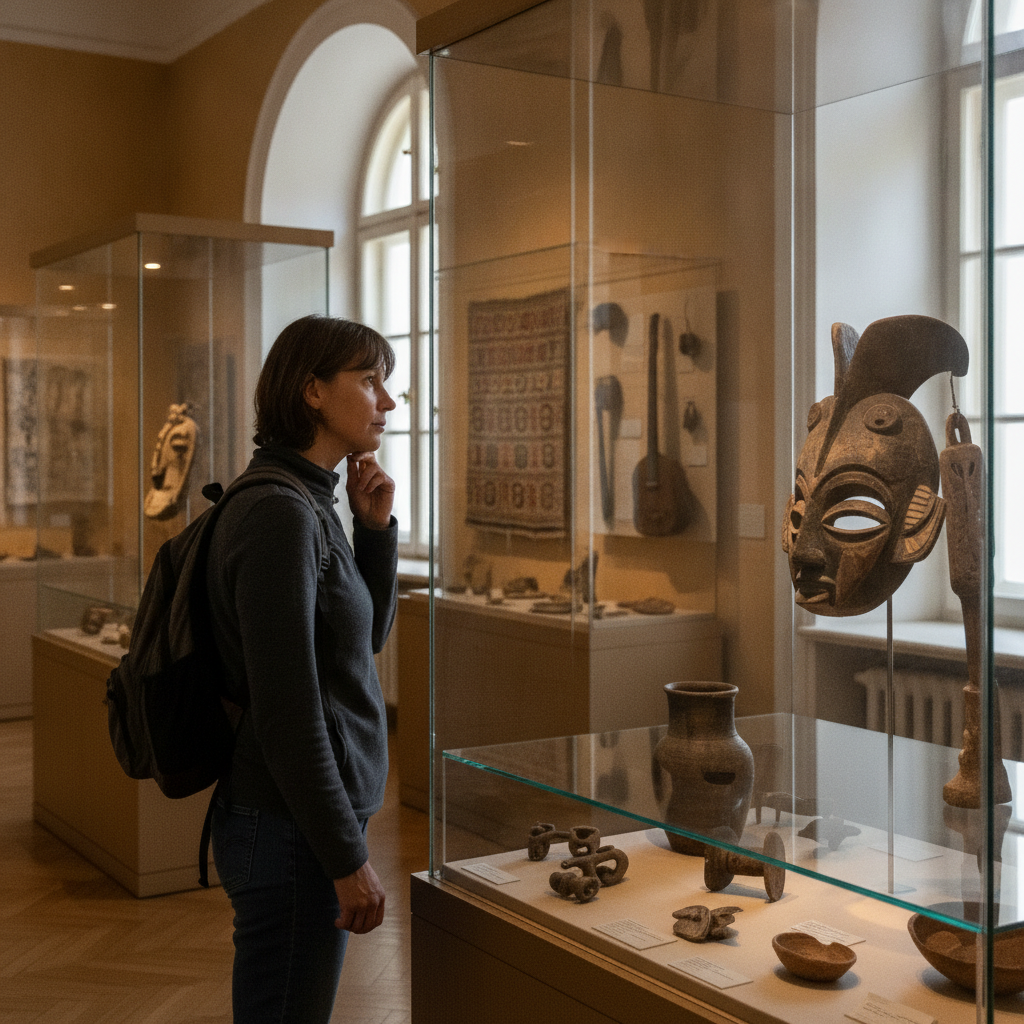
The most honest version of a culture rarely lives in its most famous building. Across Europe, Asia, and Latin America, the institutions that attract the longest queues and the most guidebook ink tend to be magnificent by design — curated for maximum legibility, staffed for crowd control, and arranged to satisfy a visitor who has perhaps four hours and a vague sense of obligation. What they offer is real, but it is also edited. The secondary collections — the municipal archive turned gallery, the craft museum tucked behind a cathedral square, the regional ethnographic institute that receives a fraction of the foot traffic — tend to offer something rarer: proximity, specificity, and the quiet confidence of a place that does not need to explain itself to everyone at once.
The Architecture of the Overlooked
Most countries operate a two-tier museum ecosystem without advertising the fact. The headline institutions — the Uffizi in Florence, the National Museum of Anthropology in Mexico City, the British Museum in London — carry enormous cultural weight and deserve their reputations. But they are also institutions shaped by the expectations of mass visitation. Their collections are lit for photography, their narratives are compressed for international audiences, and their gift shops occupy the same square footage as some smaller museums' permanent galleries. Secondary collections operate under different pressures and, as a result, different freedoms. They can afford to be eccentric, granular, and slow.
What Regional Collections Actually Contain
The category of secondary museum is broader than it first appears. It includes municipal history museums, specialist craft collections, university natural history cabinets, religious art repositories, local archaeological depositories, and the kind of single-subject institution — devoted to a regional textile tradition, a particular school of ceramics, a forgotten maritime industry — that exists because a handful of dedicated curators believed it should. The Musée de la Vie Romantique in Paris, for instance, sits a short walk from the Musée d'Orsay but receives a sliver of its visitors, offering a more intimate and textured window into nineteenth-century Parisian domestic life than the grander institution manages. These collections tend to hold objects that did not make the cut for the flagship — not because they are inferior, but because they are too particular, too local, or too strange for a generalist audience.
The Phenomenology of Unhurried Looking
There is a concept in art criticism called *durational viewing* — the practice of spending extended, uninterrupted time with a single work or object rather than moving through a collection at pace. It is extraordinarily difficult to practice in a headline institution during peak season, where the social pressure of a crowd in motion creates an invisible conveyor belt of attention. In a secondary museum, durational viewing happens almost by default. There is no one pressing behind. The guards have time to answer questions. The labels, often written by the curators themselves rather than a communications department, tend to be longer, more idiosyncratic, and more illuminating. The experience shifts from consumption to something closer to conversation.
How Secondary Collections Reflect a Culture's Self-Image
A country's flagship museums tend to reflect how it wishes to be seen by the world — grand, coherent, historically significant. Its secondary collections, by contrast, reflect how it sees itself. The Benaki Museum of Greek Culture in Athens manages both registers, but its peripheral annexes — the Islamic art collection, the Ghika Gallery housed in a neoclassical townhouse — speak to a more complicated and more honest self-understanding than the main building alone. Regional ethnographic museums in particular carry a kind of cultural candor that official institutions rarely permit themselves. They preserve the domestic, the agricultural, the devotional, and the vernacular — the textures of daily life that fall below the threshold of national narrative but constitute the actual substance of how people lived.
The Practical Case for Smaller Institutions
Beyond the intellectual rewards, secondary museums offer practical advantages that experienced travelers have long understood. Entry fees, where they exist at all, tend to be modest. Queues are rare or absent. Photography restrictions are often relaxed. Opening hours can be unconventional — some close on Tuesdays rather than Mondays, some open only in the mornings — which rewards a traveler willing to plan around the institution rather than expecting it to accommodate them. The Museo Nazionale della Scienza e della Tecnologia in Milan, the Textile Museum in Washington D.C., or the Wellcome Collection in London each offers a full afternoon of genuine engagement at a fraction of the logistical friction of a major national institution. The research required is minimal; a single afternoon with a city's official tourism site or a well-maintained travel forum is usually sufficient to surface half a dozen worthy options.
Reading the City Through Its Peripheral Institutions
For travelers who approach a destination with genuine curiosity rather than a checklist, secondary museums function as a kind of interpretive key. A morning spent in a city's textile or decorative arts collection will change how the traveler reads the architecture, the market stalls, and the domestic interiors visible through open doorways. A small museum dedicated to a region's agricultural history — to its olive oil production, its silk trade, its fishing methods — situates everything else in the landscape differently. The French term *terroir*, borrowed from winemaking to describe the totality of environmental factors that shape a product's character, applies equally well to the experience of place. Secondary museums are where the terroir of a culture becomes legible at human scale.
Changing the Way You Plan Before You Arrive
The shift toward secondary collections begins not in the museum but in the planning stage, and the change in approach is straightforward. Before your next trip, spend an hour moving past the first page of search results for any destination and looking specifically for municipal museums, university collections, specialist galleries, and heritage houses. Cross-reference with the city's own cultural listings rather than international travel aggregators, which tend to surface only the institutions large enough to advertise. Ask your accommodation host — particularly in a guesthouse or locally run apartment — which museum they would visit if they had a free afternoon. The answer is almost never the famous one. It is usually something specific, something local, something that requires a small effort to find and rewards that effort disproportionately. The culture that waits on the other side of that small effort is the one most travelers never quite reach.