There's a particular kind of disorientation that greets travellers on their first morning in a new city. The alarm goes off at an unfamiliar hour, the light through the curtains falls differently, and beyond the door lies a place that hasn't yet taken on any personal meaning. Most people respond by reaching for a phone, opening a maps application, and searching for the nearest coffee. What follows is usually serviceable — a café that caters to tourists, a croissant from a chain, a morning spent finding footing in a place that still feels like a backdrop rather than somewhere real.
The alternative to that first-day blankness isn't complicated. It begins before the trip does.
What Morning Rituals Reveal About a Place
Every city has a morning logic — a rhythm that plays out in bakeries, market stalls, and corner bars before most visitors are awake. In Lisbon, this means the *pastelaria*, the neighbourhood pastry shop where locals stand at the counter with an espresso and a *pastel de nata* before heading to work. In Istanbul, it's the *simit* cart at the street corner, the vendor with his circular sesame bread stacked high on a tray, serving the same regulars each morning. These rituals are not performed for visitors, which is exactly what makes them valuable. They represent the actual texture of daily life — unscripted, unhurried, and quietly informative.
Researching these patterns before departure means arriving with a working knowledge of where the day begins for people who actually live there. That knowledge changes the quality of the first morning entirely.
How to Research Before You Leave Home
The most useful research rarely comes from travel review platforms. Listings on those sites tend to cluster around visitor expectations — places that photograph well, cafés that speak English on the menu, bakeries that have already been absorbed into the tourist circuit. A more reliable method is to look at local food blogs written in the destination's language, run through a translation tool, or to search neighbourhood-specific community forums and resident groups.
For a trip to Copenhagen's Nørrebro district, for instance, searching for *morgenmad* — the Danish word for breakfast — alongside the neighbourhood name in Danish produces results aimed at residents rather than visitors. Apps like Foursquare still carry useful hyperlocal data when filtered by check-ins from locals rather than overall ratings. The goal isn't to build a list of places ranked by quality. It's to understand what people eat, when they eat it, and in what social setting — standing or sitting, hurried or relaxed, communal or solitary.
The Value of Arriving With a Small, Specific Plan
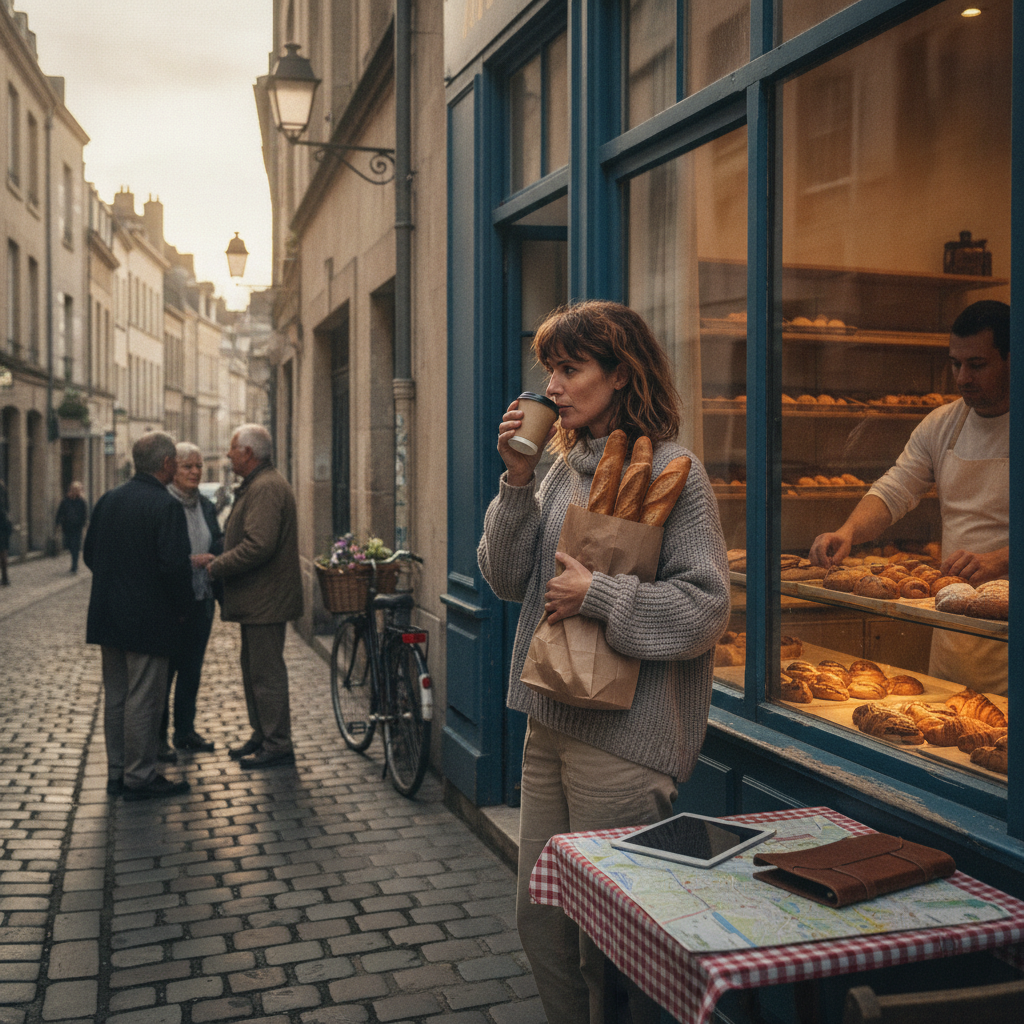
A single bakery address, written down before departure, transforms the first morning from an improvised scramble into something deliberate. It provides a destination — modest and low-stakes — that pulls a traveller into a neighbourhood rather than keeping them orbiting the hotel. The walk to get there is part of it: the street sounds, the delivery trucks, the school children, the smell of bread from half a block away. None of that happens when the morning begins with a hotel breakfast buffet or a Google Maps search from the lobby.
This approach works particularly well in cities where neighbourhood identity is strong. In Buenos Aires, the difference between Palermo and San Telmo is felt in their morning rhythms as much as their architecture. Knowing to look for a *confitería* — one of the old-style Argentine café-bakeries where medialunas are served warm with café con leche — and finding one that locals actually use rather than one flagged for tourists, gives the first morning a grounding quality that a curated itinerary rarely achieves.
Morning Routines as Cultural Orientation
What a culture eats in the morning and how it eats reflects something broader about pace, social values, and the relationship between public and private life. In Japan, the concept of *asa-gohan* — literally *morning rice* — signals a warmth and structure to the day's beginning that differs sharply from the grab-and-go model common in northern European cities. Understanding this before arriving in Kyoto doesn't just help with breakfast logistics. It recalibrates expectations about timing, noise levels, and the general tempo of the day ahead.
These small pieces of cultural context act as orientation points. They make a traveller a more attentive observer, not because the information itself is profound, but because having it signals an intention to pay attention — and that intention tends to be self-fulfilling.
Letting Research Shape the First Hour, Not the Whole Day
The purpose of this kind of pre-trip research isn't to over-plan the morning or arrive with a rigid schedule. One address, one cultural term understood, one habit observed — that's enough to shift the quality of the first waking hour from bewildered to grounded. The rest of the day can remain open, responsive, and genuinely exploratory. A first morning spent in a real neighbourhood bakery, surrounded by the unremarkable daily life of a place, does something that no landmark or guided experience replicates: it makes the city feel inhabited rather than staged.
Before your next departure, set aside twenty minutes to look past the standard recommendations. Find the name of one neighbourhood bakery that locals actually visit. Learn what people typically order and what the cultural ritual around it looks like. Write down the address and walk there on your first morning. The research won't take long, and what it produces — a first hour that feels genuinely embedded in local life rather than floating above it — has a way of colouring everything that follows. That first cup of coffee, taken in the right place at the right hour, has a way of making the rest of the trip feel more real from the very start.