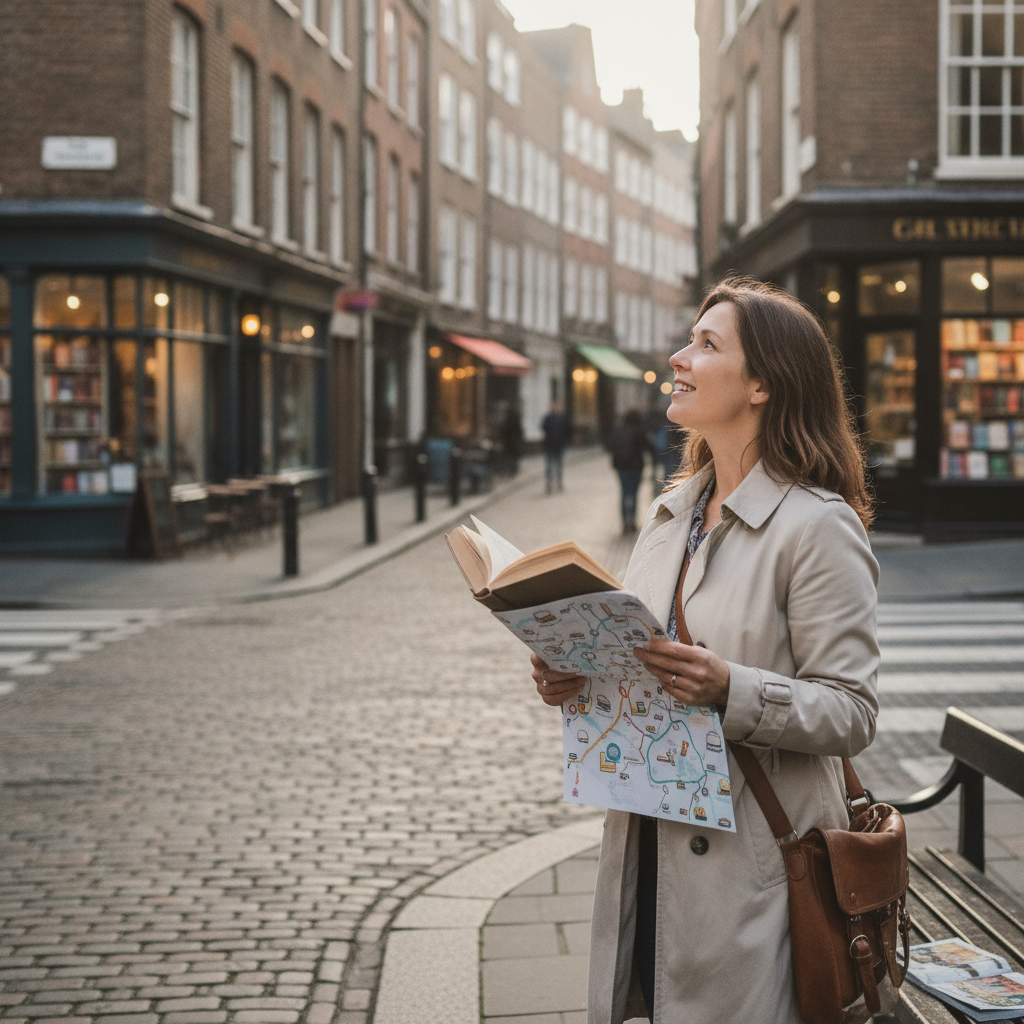
There is a particular kind of city knowledge that no official tourism map conveys — the kind that lives in side streets, in the postal districts that guidebooks skip, in the quiet geography of places that have accumulated meaning slowly rather than being designated for it. Independent bookshops tend to gather in precisely those places. Where rents are lower but foot traffic is loyal, where the surrounding neighborhood sustains a certain intellectual temperament, where the local character has resisted the smoothing-over that commercial development brings. Researching where those shops cluster before departure is less a literary exercise than a practical cartographic one. It produces a walking framework rooted in genuine local geography rather than the abbreviated circuit that most first-time visitors trace between a city's most photographed points.
The Geography of Independent Bookshops
Independent bookshops rarely open in isolation. They tend to cluster in neighborhoods that already possess a complementary texture — nearby record shops, small-batch coffee roasters, gallery spaces running on minimal overhead, wine bars that stay open late on weeknights. This clustering is not accidental; it reflects a shared economic reality and a shared audience. In Paris, the area around Rue de Buci in the 6th arrondissement — a district known for its bouquinistes, those open-air booksellers operating from green metal boxes along the Seine — extends its literary density into the surrounding streets in ways that tourist maps flatten into a single dot. In London, the concentration of independent shops around Stoke Newington Church Street signals a neighborhood character that Notting Hill's more curated equivalent no longer fully reflects. The bookshop cluster is a proxy for a living neighborhood, which is the thing the traveler actually wants to find.
Reading the Map Before the Map Exists
The research process itself is part of what makes this approach valuable. Before the trip begins, a traveler who spends time on resources like the Indie Bound directory, the Maps of Independent Bookstores project, or city-specific reading culture blogs begins to notice patterns in the data. Certain postal codes appear repeatedly. Certain neighborhood names come up in the context of author readings, small press fairs, or late-night launch events. These signals accumulate into something more useful than a list of addresses — they become a rough topology of the city, a sense of which areas carry a certain density of civic and cultural life. The exercise is similar in spirit to researching a city's public market calendar before booking, though it draws on a different set of sources and tends to surface neighborhoods that even market research misses.
How the Framework Translates Into Walking Routes
Once a traveler has identified two or three bookshop clusters in different parts of a city, the question becomes how to move between them in a way that is itself productive. The answer almost always involves walking routes that cross through the blank spaces on standard tourist maps — the transitional neighborhoods that connect one district to another, the streets that are neither destination nor thoroughfare but simply lived in. In Lisbon, moving on foot between the Príncipe Real area and the bookshops concentrated around Campo de Ourique means passing through residential blocks that most visitors on tram or rideshare would never encounter. The route becomes a sequence of observations: a neighborhood bakery, a school letting out at midday, a wall of azulejos — the traditional Portuguese blue-and-white ceramic tiles — that appears without warning on an otherwise unremarkable corner. These are not the moments that appear in curated travel content, and that is precisely what makes them worth walking toward.
What Gets Revealed in the Spaces Between
The neighborhoods that bookshop routes thread through tend to share certain qualities. They are places where the built environment has not been recently renovated for tourism, where the businesses operating at street level serve the people who live there rather than the people passing through. This distinction matters more than it might initially seem. A neighborhood that exists primarily for residents has a different quality of atmosphere — a different pace, a different noise level, a different relationship between indoors and outdoors — than one that has been optimized for visitor experience. The traveler who walks through it receives a more accurate impression of how the city actually functions, which is the kind of knowledge that makes subsequent conversations with locals feel like genuine exchange rather than the slightly scripted interaction that takes place in more heavily visited zones.
Adjusting the Framework as You Walk
One of the quiet advantages of a bookshop-based walking framework is that it remains flexible in a way that timed itineraries do not. A bookshop is, by nature, an invitation to slow down — to spend twenty minutes reading back-cover copy, to ask the person behind the counter what has been selling to locals rather than to tourists, to sit in the reading corner if one exists and simply be in the space. These pauses reshape the day organically. They create natural breakpoints that allow for spontaneous detours, for following a side street simply because it looks promising, for accepting a recommendation from someone encountered by chance. You can build a day around three bookshop visits and find that by late afternoon you have also discovered a covered market, an art deco cinema, and a courtyard that appears in no travel writing you have read. The framework holds without constraining.
The Longer Effect of This Kind of Preparation
Travelers who use independent bookshop research as a pre-trip orientation tool tend to return from cities with a different kind of memory than those who followed a conventional highlights itinerary. The knowledge they carry back is more spatial, more textured, more connected to the lived reality of the place. They remember the walk as much as the destination, the neighborhood as clearly as the shop, the conversation they had waiting for a coffee near Hackney Downs as vividly as anything they saw in a museum. This is not a sentimental outcome — it reflects the straightforward fact that preparation which engages with genuine local geography produces a genuine local experience. The research done at home, quiet and unhurried, becomes the architecture of days that feel unexpectedly full.
There is something fitting in the fact that a method built around books — objects designed to slow the reader down, to sustain attention across hours rather than seconds — should produce exactly that quality in the trip itself. The traveler who began by reading about where readers gather ends, on the last evening, sitting somewhere they would never have found otherwise, in a neighborhood whose name they now know well, with the particular satisfaction of a city understood from the inside rather than observed from its most visible edges.