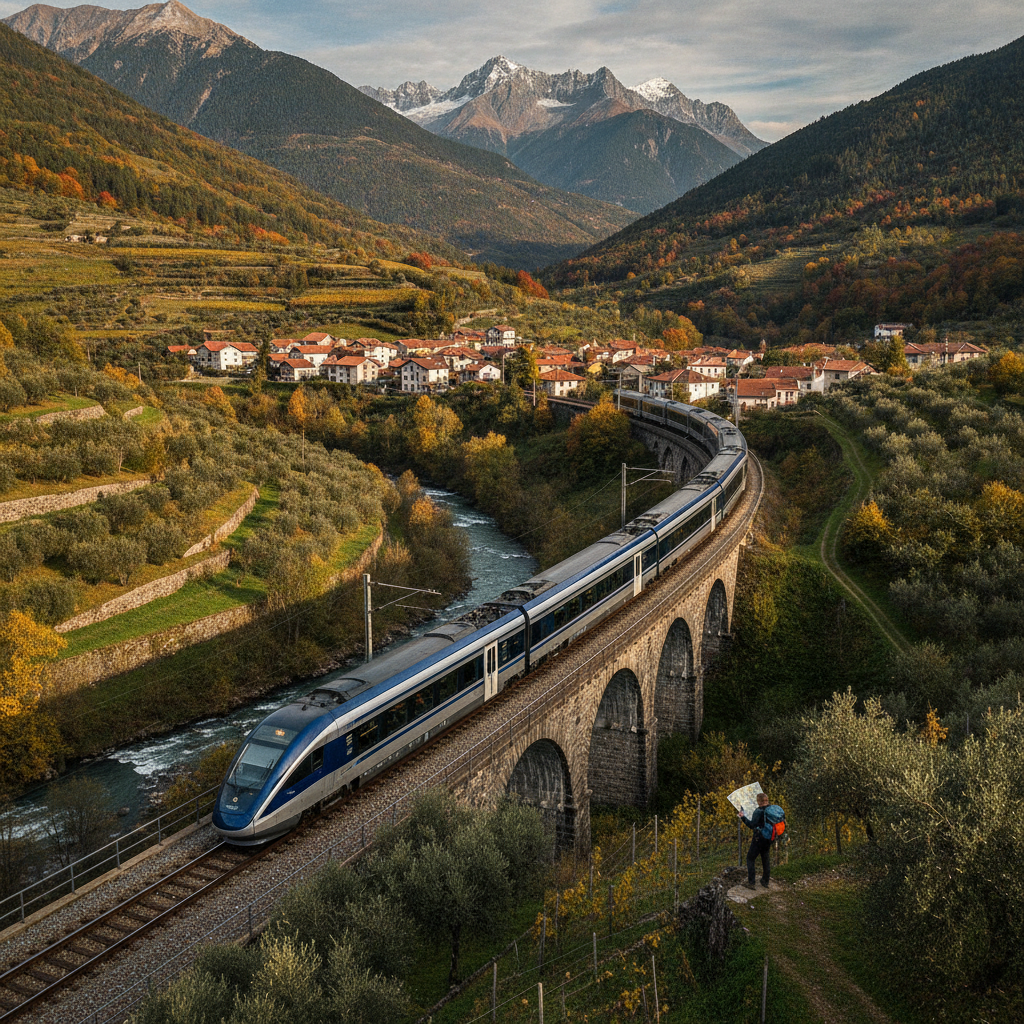
The traveler who flies between a country's major cities sees its airports, its taxi queues, and its most rehearsed attractions. The traveler who boards a regional train at dawn and watches the countryside unspool through the window sees something else entirely — the slow grammar of a place, the way the land changes tone and texture, the small stations where nobody else disembarks.
The Geography That Airports Erase
Air travel compresses distance in ways that are convenient and, in the same motion, deeply disorienting. When a traveler flies from Madrid to Seville, the two-hour flight replaces a journey that, by regional rail, would pass through olive groves, cork-oak forests, and the kind of sun-bleached towns that don't appear in guidebooks. The airport experience is, by design, interchangeable — the same retail chains, the same carpet patterns, the same fluorescent light. Regional trains, by contrast, are embedded in the geography they cross. The tracks follow river valleys because rivers shaped the land before roads did, and the stations were built where people already lived. Flying over a country is not the same as moving through it, and that distinction shapes everything a traveler carries home.
The Trenitalia regional network in Italy offers a useful illustration. The fast trains between Rome and Florence are efficient and popular, but the slower *regionale* services that branch off toward Umbria — threading through Orvieto, Narni, Spoleto — introduce a traveler to a version of Italy that has been largely bypassed by mass tourism. These towns are not obscure out of any particular effort to conceal them; they're simply off the flight path. The train makes them reachable without a rental car, without a complicated transfer, without any special knowledge beyond a printed timetable.
Slowness as a Travel Method
Building an itinerary around regional rail requires a different relationship with time — one that is less about maximizing destinations and more about allowing the journey itself to carry meaning. On a regional service in Japan, the *furusato* concept (loosely translated as "hometown" or "place of origin") becomes palpable in a way it never could from a bullet train. The slower trains stop at stations where elderly residents wait on wooden benches, where school uniforms are visible on the platform, where the architecture hasn't been updated to signal modernity. These are not performances staged for visitors; they're simply the ordinary life of a place, briefly glimpsed through a window.
This kind of travel asks something of the traveler that itinerary-by-airport does not: patience, a tolerance for ambiguity, and a willingness to arrive somewhere without a fully formed plan. The reward is proportional to that investment. A town that requires two connections and a forty-minute local service to reach is a town that most visitors will skip — which is precisely why arriving there feels like something earned rather than something consumed.
Reading the Land Between Stations
One of the underappreciated pleasures of regional rail is what happens between the stops. Landscapes that from a plane window appear abstract and unremarkable — patches of green, a river's silver glint — acquire scale and specificity at ground level. On a slow train through the Douro Valley in Portugal, vineyards arranged in terraces climb the hillsides at angles that make the labor of their creation visible. The *quintas* (wine estates) that dot the valley are not the official attraction; they're simply what exists, and the train passes through the middle of it without ceremony.
This capacity for accidental discovery is one of the most durable arguments for rail-centered itineraries. A traveler who spots an interesting-looking hilltop village from a train window can check a map, note the nearest station, and plan an impromptu detour in a way that no flight schedule would permit. Regional rail treats geography as a resource rather than an obstacle, and travelers who adopt that same orientation tend to return home with stories that don't overlap with anyone else's.
Letting the Network Decide the Itinerary
There's a practical philosophy in surrendering some planning authority to the train network itself. Rather than selecting a list of cities and working backward to logistics, the approach inverts: open the regional rail map, identify which lines pass through unfamiliar territory, and let that structure suggest the route. In Germany, the regional *Regionalbahn* services that operate outside the ICE high-speed network connect towns like Quedlinburg, Görlitz, and Bamberg — places that carry enormous historical and architectural weight but receive a fraction of the visitors that Munich and Berlin do.
When you let the timetable become the framework, the trip gains a coherence that comes not from a highlights list but from actual geography. Towns begin to make sense in relation to each other — why this valley became a trading route, why this border town has an architecture that mixes two national traditions, why the food changes noticeably after a certain ridge. These connections are invisible at altitude and self-evident at ground level, seen through the window of a slow train moving at a pace the land itself seems to understand.