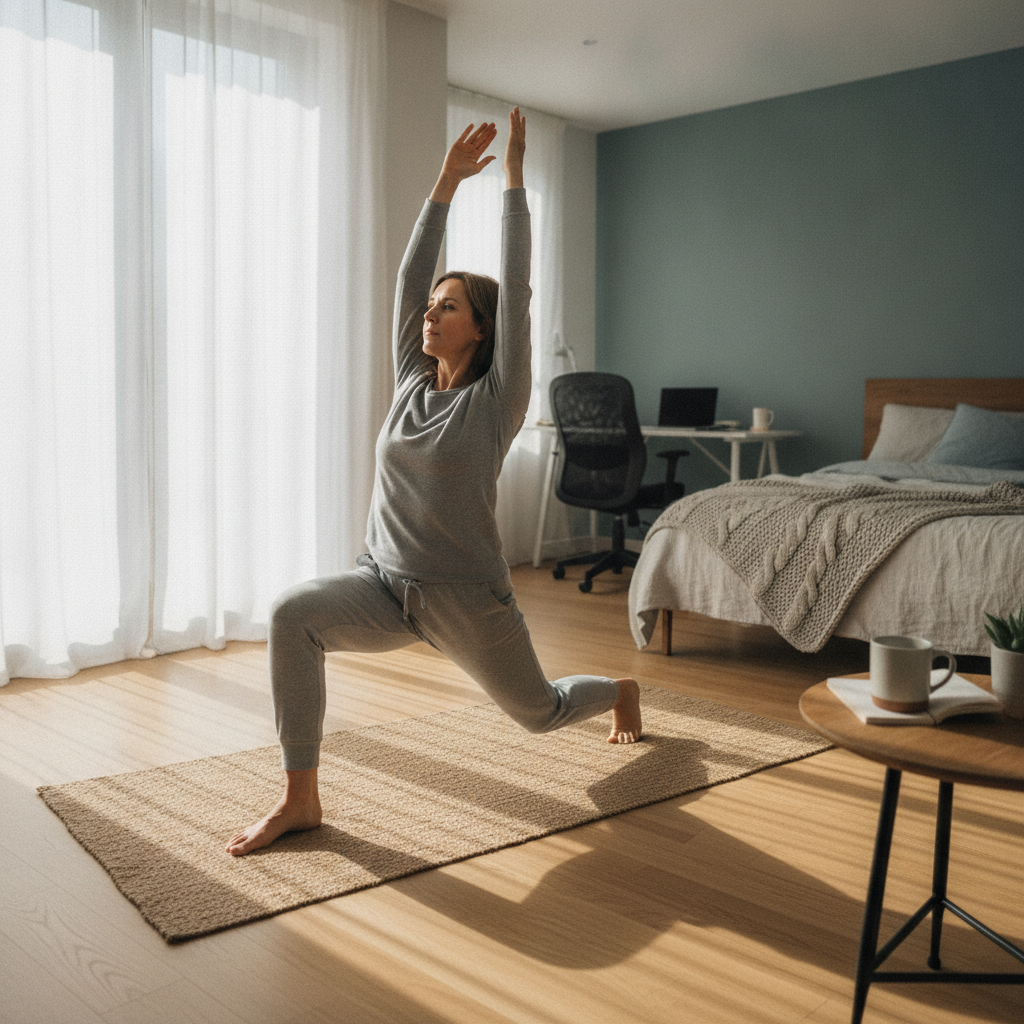
Most people accept morning stiffness as an unavoidable tax on adulting — a few creaky minutes before the body loosens up and life resumes. But what feels like a minor inconvenience at 7 a.m. has a way of compounding quietly throughout a sedentary workday, layering tension on tension until that low-grade tightness in your hips or lower back becomes something harder to ignore. A short mobility sequence done right after waking — we're talking five to ten minutes — can interrupt that cycle before it starts. It's not about turning your morning into a full workout. It's about giving your joints and connective tissue a deliberate reset while your nervous system is still warming up.
Roll Through the Spine Before You Stand Up
Before your feet even hit the floor, your spine has been compressed in the same position for six to eight hours. Spending two minutes on gentle spinal movement while still in bed — drawing your knees to your chest, rocking slowly side to side, or doing a supine twist — sends synovial fluid back into the vertebral joints and signals your nervous system to shift out of its overnight resting state. This isn't passive stretching. The slow, rhythmic movement pattern actually primes the proprioceptive pathways your body uses to coordinate movement throughout the day. Think of it as rebooting the system before you ask it to carry a full workload.
Open the Hips With a 90/90 Position
Sitting compresses the hip flexors and rotators into a shortened, loaded position for hours at a time. The 90/90 hip stretch — where you sit on the floor with both legs bent at ninety degrees, one in front and one behind — works both internal and external hip rotation simultaneously, which most stretches miss entirely. Hold each side for sixty to ninety seconds, breathing slowly and letting the tissue release rather than forcing the position. Apps like StretchIt offer guided versions if the setup feels unfamiliar. Over time, this single position does more for hip mobility than most people realize, particularly if your chair time runs long.
Mobilize the Thoracic Spine Against a Foam Roller
The thoracic spine — the middle and upper back — is one of the first areas to lose range of motion in desk workers, and its stiffness has a ripple effect on neck tension, shoulder tightness, and even breathing depth. Placing a foam roller horizontally across your mid-back and gently extending over it for thirty seconds at two or three different levels takes less than two minutes. Brands like TriggerPoint make high-density rollers that hold up well over time and don't flatten out with daily use. This movement restores extension in a region that spends most of the day rounded forward, and the relief is usually immediate and noticeable.
Add a Cat-Cow Flow to Warm the Lower Back
Cat-cow is one of those movements that looks almost too simple to matter — and yet it reliably works. Moving the lumbar spine through flexion and extension in a slow, breathing-linked rhythm lubricates the facet joints, activates the deep spinal stabilizers, and gently wakes up the muscles that will support your posture all day. Aim for eight to ten slow repetitions, letting the exhale guide the rounding and the inhale guide the arch. The key is not rushing it. When you move through this sequence deliberately, syncing breath with motion, it shifts your nervous system toward a calmer, more regulated state — which is exactly where you want to start the day.
Activate the Glutes Before They Spend the Day Switched Off
Sitting effectively puts the glutes into a prolonged off state — they're not contracting, not stabilizing, not doing much of anything. Over time, this leads to what's sometimes called gluteal amnesia, where the body starts relying on the lower back and hip flexors to compensate for work the glutes should be doing. A simple activation sequence — glute bridges, clamshells, or even standing hip hinges against a wall — wakes these muscles up before they're asked to contribute. The Peloton app includes short mobility and activation sessions that fit neatly into a five-minute morning window if you want a structured option rather than self-directing.
Lengthen the Hip Flexors With a Low Lunge Hold
The psoas and iliacus — the primary hip flexors — shorten significantly with sustained sitting and stay in that shortened state well into the following morning if nothing is done to counteract it. A low lunge hold, where one knee is on the ground and you gently press the hips forward while keeping the torso upright, creates a long, sustained stretch through the front of the hip. Hold for ninety seconds on each side, breathing steadily. This isn't about achieving a deep yoga posture. It's about mechanically restoring length to a tissue that's chronically shortened, which reduces the anterior pelvic tilt that drives so much low back discomfort in desk workers.
Finish With Shoulder Circles and Neck Rolls
The neck and shoulders tend to absorb a disproportionate share of daily tension, especially if your workstation setup isn't ideal or if you carry stress physically. Slow, controlled shoulder circles — both forward and backward — move the glenohumeral joint through its full range and warm up the rotator cuff before it's asked to hold a keyboard-forward position for hours. Follow with gentle neck rolls, avoiding any sharp or forced movement. This final piece of the sequence takes about ninety seconds and signals to your body that the full system has been attended to, not just the lower half. It's a small thing that creates a noticeable sense of physical readiness.
Build the Habit by Pairing It With Something Fixed
The fastest way to make a new movement habit stick is to attach it to something that already happens automatically every morning. Putting your yoga mat or foam roller next to the bed the night before removes the friction of decision-making. Pairing the sequence with your first cup of coffee — do the mobility work while it brews — gives it a clear trigger. Apps like Streaks can help you track the habit without turning it into a performance metric. The sequence doesn't need to be perfect or complete every single day to work. Even five minutes of intentional movement, done consistently, interrupts the pattern of accumulated stiffness far more effectively than occasional longer sessions.
Morning mobility is one of those practices that tends to grow quietly in importance the older you get and the more sedentary your days become. What starts as a simple way to feel less creaky before 9 a.m. often becomes a meaningful investment in how your body holds up over years of desk work, long commutes, and the general wear of modern life. The longer you stay with it, the more clearly you'll notice the difference on the mornings you skip it — which is usually enough to keep you coming back.