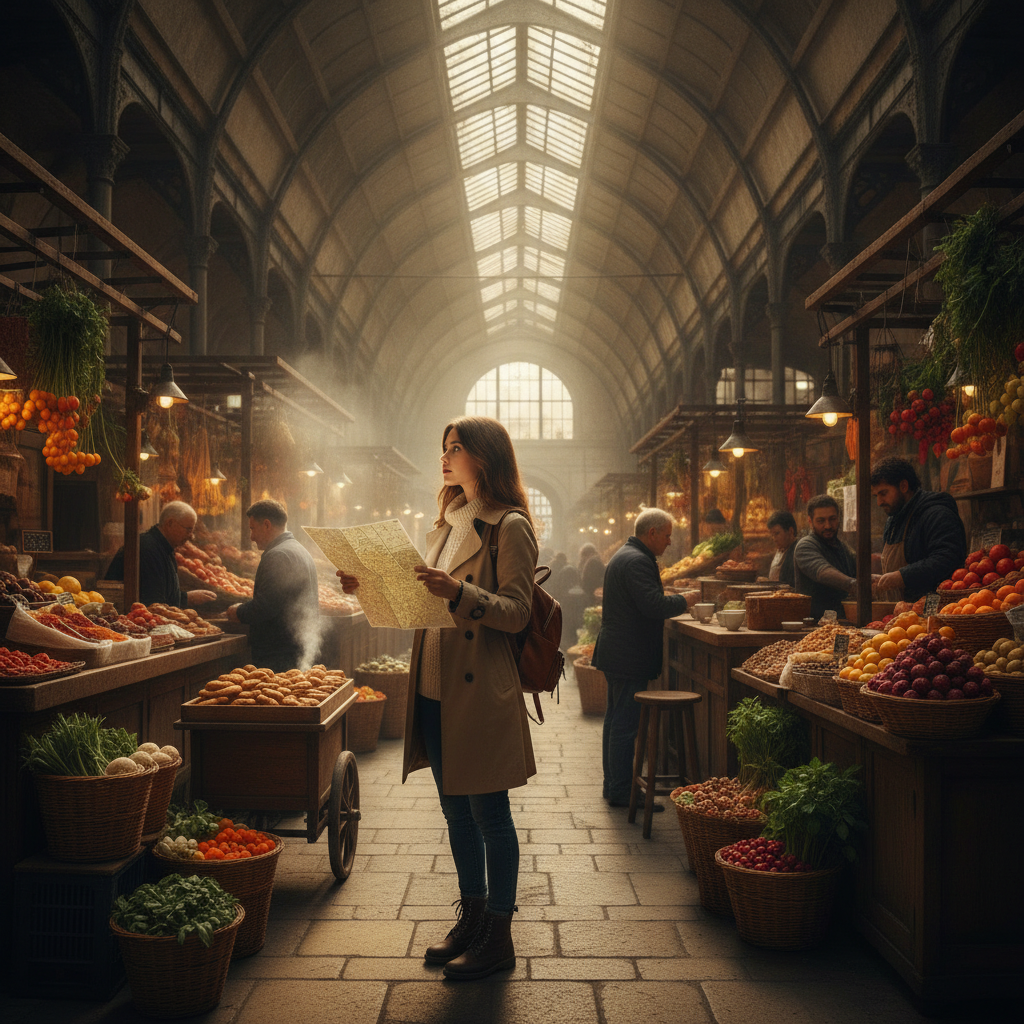
Most travelers arrive in a new city and immediately orient themselves toward the obvious — the cathedral, the famous square, the viewpoint everyone has already photographed a thousand times. It's an understandable instinct. You've done the research, you know what the place looks like, and you want to confirm it in person. But that first morning sets a tone that tends to carry through the entire trip, and when you spend it chasing the expected, you often leave feeling like you've seen the city without quite having been inside it.
Spending your first few hours in an old covered market changes the equation entirely. Markets like Budapest's Great Market Hall, Barcelona's Boqueria, or Istanbul's Mısır Çarşısı aren't just convenient places to grab breakfast — they're compressed, living versions of how a city actually functions. The vendors, the rhythms, the sounds, the things locals are actually buying on a Tuesday morning: all of it builds a kind of intuitive map that no guidebook can replicate. Once you've spent a morning inside a market, you start reading the rest of the city differently.
Arrive Before the Tourist Flow Starts
Covered markets run on their own schedule, and the best version of them exists in that window between 7 and 9 a.m. before tour groups arrive and the dynamic shifts. Locals shopping for the week, vendors arranging displays, coffee being served to the same regulars who come every day — this is the unfiltered version of the place. You're not performing tourism yet. You're just present in a space that wasn't set up for you, which is precisely what makes it feel real. Getting there early isn't just a tactical tip — it's a different category of experience.
Use the Market to Build a Mental Neighborhood Map
Markets don't exist in isolation. They're embedded in neighborhoods that grew up around them, and those neighborhoods tend to have their own character — specific streets, specific kinds of shops, specific bakeries that only locals know about. Spending time inside a market gives you an organic reason to explore the streets that feed into it. You start noticing which direction the delivery trucks come from, which cafés the vendors use, which alley the fishmongers cut through at the end of their shift. That kind of spatial knowledge grounds you in a city in a way that standing in front of a famous façade simply doesn't.
Eat Something You Didn't Plan to Eat
One of the most reliable ways to move past the surface layer of a place is to let the food be genuinely unexpected. In a covered market, that happens naturally — you'll encounter something being prepared at a stall that you didn't know existed, a regional specialty with no English description, something being sliced or ladled or grilled that your research never turned up. Order it. Eat it standing at a counter if that's how it's meant to be eaten. The willingness to be surprised by something as simple as breakfast recalibrates your whole approach to the day.
Notice What Locals Are Actually Buying
This is more useful than it sounds. The produce and products that move fastest through a market tell you something specific about what's in season, what's valued, and what the local kitchen actually looks like — not the version of it presented to tourists. If you're in Valencia and you see paella rice and fresh rosemary moving by the kilogram, that tells you something. If you're in Marrakech's covered spice section and certain blends are pre-measured and clearly for everyday use, that's information too. Shopping patterns are a form of cultural fluency you can pick up without speaking a word of the language.
Let One Conversation Anchor the Day
Markets are one of the few places where brief, genuine exchanges between strangers still happen naturally. A vendor explaining what something is, a recommendation from the person standing next to you at a cheese counter, a brief back-and-forth over how to prepare something you just bought. These aren't the kinds of interactions you engineer — they happen because the setting allows for them. One real conversation early in a trip has a way of softening the mild alienation that comes with being somewhere new, and it tends to make the rest of the day feel more open.
Save the Landmark for the Afternoon
The famous cathedral, the iconic bridge, the square that's on every travel poster — none of it is going anywhere. Saving those for the afternoon, after you've spent a morning in the market, means you arrive at them with context. You've already met the city in its working clothes. The landmark starts to feel less like a destination and more like a reference point in a place you're beginning to understand. The photograph you take at 3 p.m., after a morning in the market, will likely mean more to you than the one you would have taken at 9 a.m. off the airport shuttle.
Let the Market Set the Pace for the Whole Trip
The rhythm of a covered market — unhurried, sensory, built around presence rather than efficiency — is worth carrying forward. Trips that start this way tend to produce travelers who linger at small things, who deviate from the itinerary without anxiety, who end up in the kind of unremarkable side street restaurant that becomes the meal they talk about for years. Apps like Rome2rio and Komoot are useful for logistics, but the pace you set on day one is harder to find in any app. A market morning teaches it instinctively.
The way travel culture is shifting points toward exactly this kind of recalibration. More travelers are deliberately building itineraries around daily life infrastructure — markets, neighborhood bakeries, transit hubs — rather than around landmark checklists. It's a quieter approach, and it tends to produce trips that feel less like a performance of having been somewhere and more like an actual encounter with a place. Your first morning sets that tone, and a covered market is one of the most reliable ways to get it right.