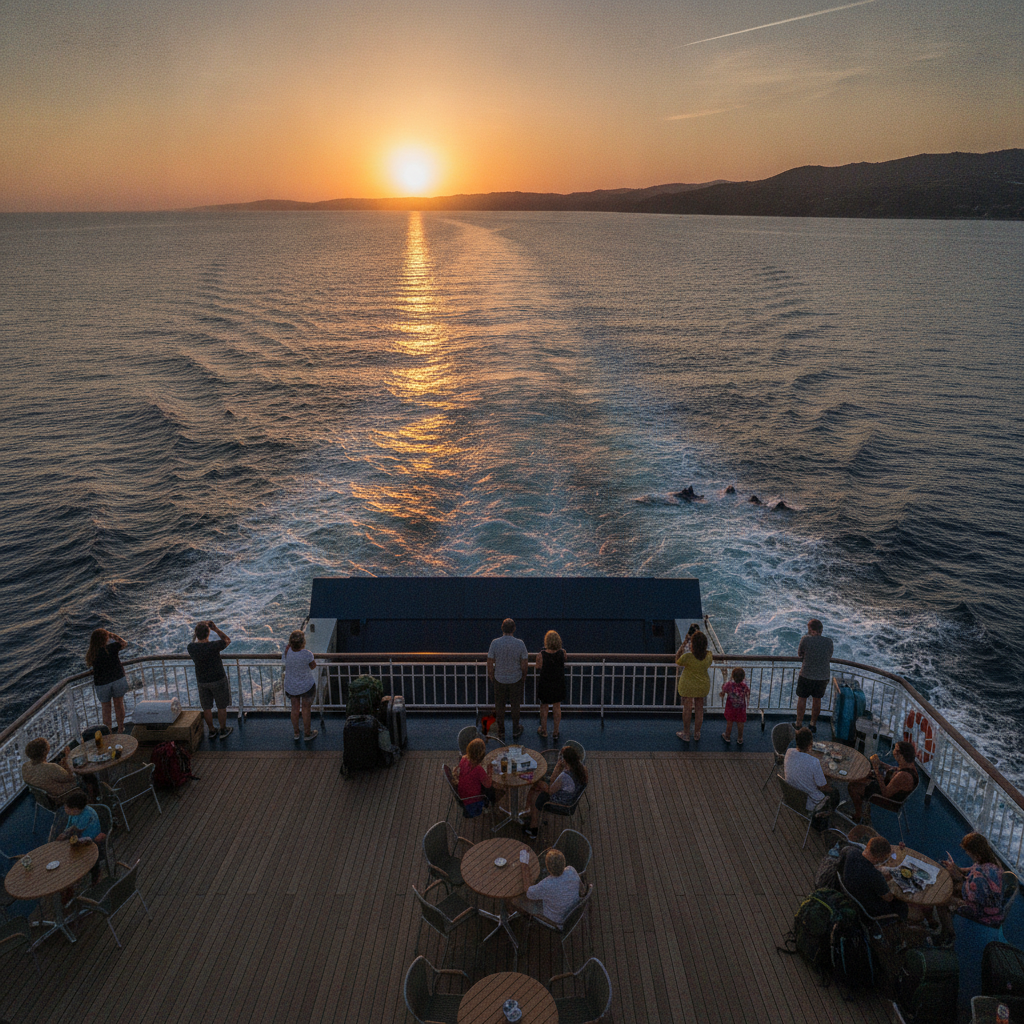
There is a particular kind of travel that begins the moment the gangway lifts and the harbor slowly shrinks behind the stern — a mode of moving through the world that refuses to compress time into a pressurized tube hurtling above the clouds. The long-distance ferry belongs to an older, more patient tradition of travel, one that treats the crossing itself as a destination rather than an inconvenience to endure. In an era when short-haul flights have made hopping between coastal cities almost frictionless, something worth examining has been quietly lost: the experience of being genuinely between places, suspended on open water with hours to fill however one chooses.
The comparison between a ferry and a budget flight is rarely made on equal terms. Airlines have conditioned travelers to measure journeys in units of pure efficiency — gate to gate, boarding to landing, seat belt sign on to seat belt sign off. A ferry crossing, by contrast, operates on a different logic entirely. The Greek concept of *scholē* — leisure understood not as idle time but as purposeful, unhurried engagement with one's surroundings — captures something of what a long sea crossing offers that a forty-five-minute flight simply cannot. You arrive not as cargo delivered to a destination, but as someone who has genuinely traveled there.
The Geometry of Slow Movement
Long-distance ferry routes across open water — the overnight crossings between Ancona and Split, the Stena Line services through the Irish Sea, the sprawling archipelago ferries of the Finnish coast — all share a quality that no short-haul aviation experience can replicate: they move through geography rather than above it. As a vessel rounds a headland or threads between islands at dusk, the traveler is reading a landscape the way it was once always read, from the water, at a pace that allows the eye to settle and the mind to absorb. The shoreline doesn't flash by at cruising altitude; it unfolds over hours, receding and approaching, lit differently as the light changes. There is a compositional quality to this kind of movement that registers differently in memory than any window-seat aerial view.
The physical experience matters, too. Ferry crossings return a certain bodily awareness to travel — the gentle pitch and roll of the deck, the salt air that makes its way through any open companionway, the particular sound of water displaced by a hull at speed. These are not discomforts so much as sensory anchors, the kind that mark an experience as genuinely distinct from ordinary life. A short-haul flight, stripped of such texture, tends to leave little impression beyond mild irritation at the boarding process.
What the Crossing Does to Time
One of the underappreciated qualities of a long ferry journey is what it does to the traveler's relationship with time — specifically, how it restores a sense of time as something to inhabit rather than consume. On a flight between, say, Barcelona and Palma, the journey lasts roughly fifty minutes and demands almost nothing from the passenger beyond compliance. There is no opportunity for a proper meal, no space to read at length without interruption, no rhythm to settle into. The ferry equivalent of that same crossing, departing from Valencia and arriving in Mallorca across several hours, allows something closer to what the Japanese call *ma* — the productive quality of an interval, a pause that carries meaning in itself.
Passengers on long ferry crossings tend to organize themselves naturally into a kind of loose shipboard community. Meals are taken in proper dining spaces. Decks become informal social zones where strangers share observations about the horizon. There is something in the shared experience of open water that loosens the self-contained armor most travelers carry through airports. The crossing creates a shared temporality — everyone aboard is going to the same place at the same pace — and that shared condition produces a mild but genuine sense of fellowship that no airport lounge replicates.
Practical Realities Worth Knowing
Beyond atmosphere and philosophy, the long-distance ferry often makes straightforward practical sense. Travelers who would otherwise pay checked baggage fees, arrive two hours early for security, and then discover their destination airport sits forty minutes outside the city center may find that the ferry's apparent slowness is partially illusory. A cabin on an overnight crossing between Dublin and Holyhead or Santander and Portsmouth effectively doubles as accommodation, removing a night's hotel cost from the budget entirely. The vessel docks in the heart of port cities — often closer to where a traveler actually wants to be than any regional airport — and there is no weight limit on what fits in the car hold.
Routes operated by carriers such as Brittany Ferries, DFDS, and Grimaldi Lines have invested significantly in the passenger experience aboard longer crossings, with restaurant-quality dining, private cabins, and proper deck spaces that make an overnight journey feel less like transit and more like a short cruise. The economics, once the full picture is accounted for, frequently favor the ferry.
What You Carry Off the Boat
When you step onto a foreign quayside after a long crossing, the arrival feels earned in a way that deplaning rarely does. The hours at sea have given the destination time to approach in the imagination, to become real gradually rather than suddenly. There has been space to feel the distance between home and wherever one is going — space that a flight compresses into a brief sensation of altitude and then erases entirely. Travelers who arrive by ferry tend to carry a particular kind of readiness into the first hours of a trip, a quality of attention that comes from having genuinely made a journey rather than simply been moved from one point to another.
That quality of arrival echoes something the opening image of a shrinking harbor already suggests: that travel, at its most meaningful, is not about minimizing the distance between two places but about letting the distance itself become part of what you experience. A long ferry crossing doesn't slow a trip down — it opens it up, turning what would have been dead time in a terminal into hours of sea air, shifting light, and the slow, satisfying certainty that you are already, unmistakably, on your way.