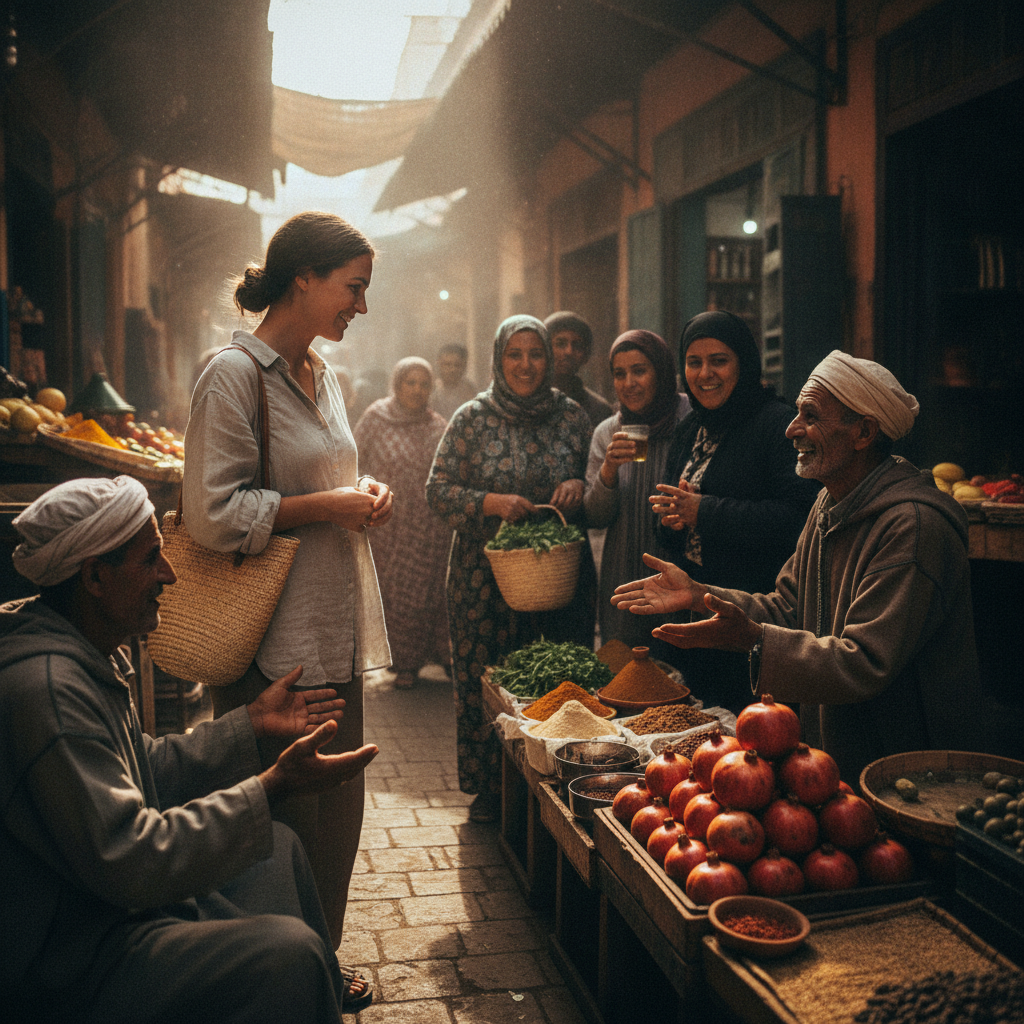
There is a particular moment that seasoned travelers recognize almost immediately — the subtle shift in a local's expression when a visitor attempts even a few words in the native language. The eyes soften. The posture opens slightly. What was a transactional exchange becomes something closer to a small, genuine connection. It happens in market stalls in Marrakech, at coffee counters in Kyoto, and in the narrow grocery lanes of neighborhoods in Lisbon's Mouraria district. The moment is brief, but its effect on the entire tone of a trip is not.
The Gap Between Tourist and Guest
Most travelers arrive in a foreign country carrying a translation app and reasonable confidence that English will carry them through. And in most destinations, it will — practically speaking. But practical and meaningful are different registers of travel entirely. The tourist who gestures at a menu and points is understood. The visitor who offers a simple *por favor* in Portugal or a softly pronounced *onegaishimasu* in Japan — a polite request in Japanese — communicates something beyond the words themselves. They signal that they know they are a guest in someone else's place and that they have made a small effort to meet that place halfway. Locals notice, and they respond differently to it, not out of obligation, but out of something that resembles quiet appreciation.
Language learning, in the context of travel preparation, is often framed as a fluency goal — learn conversational Spanish before visiting Mexico City, master Mandarin tones before flying into Chengdu. That framing is both unrealistic for most people and beside the point. Ten phrases learned well, rooted in the specific contexts a traveler will actually encounter, carry more social weight than two hundred vocabulary words studied in the abstract. The goal is not comprehension. The goal is recognition — the kind that signals respect.
Choosing Phrases That Fit Real Moments
The ten phrases worth learning are not the ones listed first in a generic phrasebook. *Hello*, *thank you*, and *where is the bathroom* have their place, but they represent the floor of effort, not the ceiling. The phrases that produce genuine warmth are the ones tied to specific rituals of local life. In Japan, saying *itadakimasu* before eating — an expression of gratitude for the meal and those who prepared it — lands differently than a foreign visitor simply picking up chopsticks. In Morocco, greeting a shopkeeper with *as-salamu alaykum* before any transaction acknowledges a cultural and spiritual courtesy that matters to the person receiving it. In Greece, a well-placed *yamas* during a shared meal, the Greek equivalent of a convivial toast, signals that the visitor is present in the moment rather than merely passing through it.
The process of choosing which ten phrases to learn is itself a useful exercise in cultural preparation. It requires a traveler to think ahead about where they will actually be — which neighborhoods, which kinds of shops, which social situations — and to research the small rituals and customs that define daily life in those places. The Duolingo app, travel forums on Reddit's r/travel community, and language-exchange platforms like Tandem all offer accessible starting points. But the most effective preparation comes from identifying the specific contexts that will arise and working backward to the phrases that serve them.
What the Effort Actually Communicates
The social effect of learning context-specific phrases is not about linguistic accuracy. Native speakers are not evaluating a foreign visitor's pronunciation with a critical ear. What they are registering is something more elemental: the willingness to be vulnerable in their language, however briefly. Mispronunciation is not embarrassing in this context — it is, if anything, endearing. It confirms that the words were learned recently and imperfectly, which is to say honestly. There is a French term, *bonne volonté*, that translates roughly as goodwill or good faith, and it captures precisely what locals perceive when a visitor makes the attempt. The phrasing may be clumsy. The intent is transparent.
This shift in local response has practical consequences as well as emotional ones. Vendors in open-air markets in places like Istanbul's Grand Bazaar or the Mercado de San Miguel in Madrid are more likely to engage warmly, offer recommendations, or extend small courtesies — an extra sample, a more patient explanation, a smile that isn't performed for commerce — when the interaction begins in their language rather than in the traveler's. The experience of the destination changes not because the destination has changed, but because the traveler's social position within it has shifted slightly from outsider to someone making a genuine effort.
Before You Go
If you are planning a trip, the most useful thing you can do in the two weeks before departure is not to review your itinerary one more time. It is to learn ten phrases so specifically suited to the moments you will encounter that saying them feels almost like a rehearsed kindness. Look up the way people greet each other in the part of the country you are visiting — regional expressions often differ meaningfully from textbook versions. Learn how people express gratitude in informal settings versus formal ones. Find out if there is a phrase associated with hospitality or sharing a meal, since those tend to carry particular warmth when offered by a visitor. Practice the pronunciation enough that the words come out smoothly rather than haltingly, because fluency in those ten phrases matters more than a broad vocabulary delivered uncertainly.
The traveler who walks into a small family-run restaurant in Oaxaca and greets the owner with a genuine *buenas tardes* before sitting down has already had a different trip than the one who waited to be acknowledged. The language didn't open the door. The intention behind learning it did. That is the quiet truth that veteran travelers carry home alongside their photographs — that the places they remember most vividly are rarely the ones where they were most comfortable, but the ones where they made the smallest, most deliberate effort to belong.