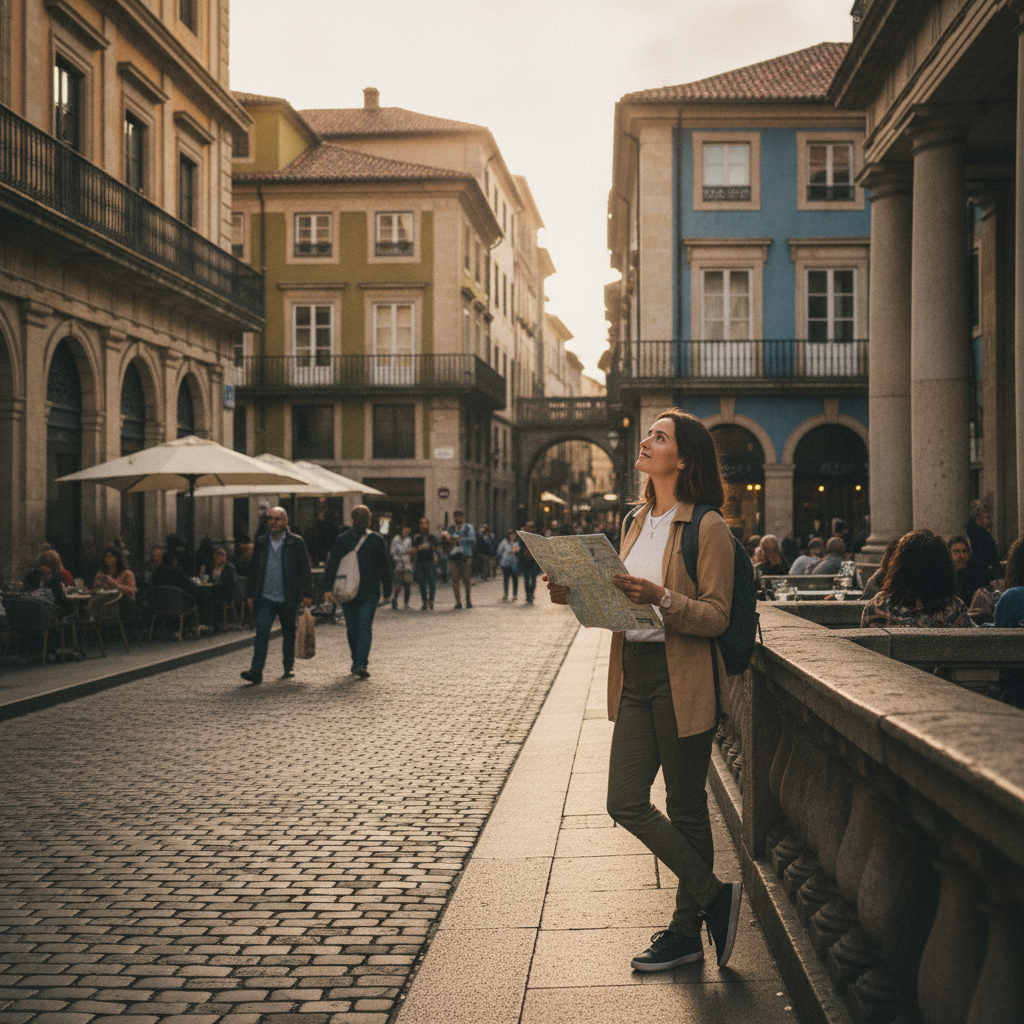
The traveler who arrives with nothing planned tends to remember everything. The one who follows a curated tour remembers the highlights — which, it turns out, are someone else's highlights.
There's a particular kind of knowledge that only comes from wandering without direction, especially in those early hours when a place is still completely foreign. The sounds feel unfamiliar, the logic of the streets hasn't clicked yet, and the brain is working hard to make sense of things it can't yet categorize. That cognitive friction, uncomfortable as it can be, is exactly where real orientation begins.
What Guided Tours Actually Deliver
Guided tours serve a genuine purpose. They compress context into manageable portions, they explain historical weight that a solo wanderer might miss entirely, and they spare you the inefficiency of going the wrong way for an hour. In cities like Lisbon or Kyoto, where centuries of layered history live inside a single street, a good guide can be transformative. The problem isn't the tours themselves — it's using them as the first experience of a place rather than a follow-up to independent discovery.
When a tour becomes the opening act, it hands the traveler a pre-assembled mental map. You learn what the tour operator considers essential, in the order they've decided makes sense, framed through the lens they've refined for visitors. The information is accurate. The sequence, however, is artificial — and the brain stores spatial and cultural knowledge most effectively when it's earned through actual experience, not delivered.
How Unstructured Time Builds Spatial Intuition
Psychologists who study spatial cognition have long observed that humans build mental maps through movement, error, and recalibration — not passive reception. When someone walks without a plan, they unconsciously register relationships between landmarks, gauge distances through effort rather than estimation, and develop a felt sense of direction that no map application fully replicates. This is sometimes called *cognitive mapping*, the internal process by which a place becomes genuinely legible rather than just recognizable.
A traveler who spends a morning getting mildly lost in the Karaköy neighborhood of Istanbul, stumbles into a tea house, doubles back through a covered market, and eventually finds their way to the waterfront by following foot traffic — that traveler has built something. They've created a web of spatial associations that will make every subsequent day in that city feel anchored. The person who arrives at the same waterfront by tour bus at 10 a.m. has seen it, but hasn't placed it.
Shorter bursts of purposeless walking tend to produce more lasting orientation than longer, directed routes. The brain consolidates places better when it has had to work for them.
The Role of Sensory Overload in True Arrival
The first full day in a new country is genuinely disorienting, and it's supposed to be. There's a concept in anthropology called *liminality* — the threshold state between two conditions, where old frameworks no longer apply and new ones haven't yet formed. Travelers are in a liminal state for roughly the first twenty-four to forty-eight hours, and that window is precisely when unstructured experience does its most important work.
Without an itinerary, the senses have to do the orienting. The quality of light at midday. The smell near the harbor versus the old town. The rhythm of a market street at nine in the morning compared to noon. These sensory details don't appear in any guidebook, and they're the ones that make a place feel genuinely inhabited rather than visited. They're also the details that surface in memory months later, long after the official landmark photos have blurred together.
The discomfort of not knowing what to do next is, in this context, productive. It forces presence in a way that a packed schedule never can.
When to Reintroduce Structure
None of this argues against planning. A well-constructed itinerary from day two onward — one that includes specific sites, restaurant reservations, perhaps a walking tour through Trastevere in Rome or a night market in Chiang Mai — lands entirely differently once the traveler has already built a baseline orientation. The structured experience layers onto something real rather than replacing the process of building it.
The apps and platforms that now shape most trip planning — Google Maps, Airbnb Experiences, GetYourGuide — are most useful as a second layer rather than a first. Use them to deepen what free wandering has already introduced. Book the tour that takes you back to the neighborhood you stumbled into alone. Choose the restaurant that sits on the corner you passed three times without knowing what it was.
What to Watch for as Travel Culture Evolves
The broader shift happening in travel right now is away from optimized itineraries and toward what some call *slow discovery* — a mode of travel that treats disorientation as an asset rather than a problem to solve. As AI-generated trip plans become more sophisticated and more dominant in how people prepare for trips, the value of genuinely unscripted time will only increase. The traveler who arrives somewhere having already been handed a perfect twelve-day plan risks spending two weeks confirming expectations rather than forming them. The first day without an agenda is increasingly rare, which is precisely what makes it worth protecting. A country reveals itself most honestly to the person who hasn't yet decided what they're looking for — and that first full day, walked without a plan, becomes the foundation everything else is built on.