There is a particular kind of arrival — the kind that happens in a tiled hallway that smells faintly of cardamom and laundry soap, where someone's grandmother hands over a room key without a digital check-in terminal in sight — that reorients a traveler before they've even set down their bag. It doesn't announce itself as a meaningful moment. It simply is one. And yet the decision that led to that hallway, the choice of a family-run guesthouse over a branded hotel, quietly reshapes everything that follows: what gets eaten for breakfast, which streets get walked, which conversations happen by accident, and which version of a place a person actually encounters.
The Geometry of a Trip Changes at the Door
Chain hotels are engineered for seamlessness. The lobby of a Marriott in Lisbon and the lobby of a Marriott in Chiang Mai share a deliberate grammar — the same lighting temperature, the same check-in choreography, the same breakfast buffet logic. That consistency is genuinely useful for certain kinds of travel: business trips, transits, situations where the hotel is a container, not a destination. But when someone is traveling to understand a place rather than simply pass through it, that seamlessness starts to work against them. The building becomes a buffer between visitor and city, a soft insulation that keeps the unfamiliar at arm's length. A family guesthouse operates on entirely different premises. The building is already embedded in the neighborhood's logic — its hours, its rhythms, its relationship to the street outside.
What Hosts Know That No App Captures
In Oaxaca, a guesthouse owner might mention, without being asked, that the market on Calle Mina is better on Tuesday than Saturday, that a particular mezcal producer two towns over welcomes visitors who call ahead, and that the bus to Monte Albán leaves earlier than the tourist office suggests. This is the category of knowledge that platforms like TripAdvisor and Google Maps structurally cannot hold — not because the information doesn't exist, but because it lives in relationships, not databases. A host who has been welcoming guests for fifteen years has accumulated a layered, practical, affectionate understanding of their own place. They know what changed after the last election, which restaurant quietly got better, which neighborhood feels different after dark. Staying in their home is, in effect, borrowing a small piece of that accumulated awareness. The trip becomes less like reading a guidebook and more like being introduced to a city through someone who actually loves it.
The Economic Current Runs Differently
Money spent at a family guesthouse moves through a community in a fundamentally different way than money spent at a chain property. When a traveler pays for a room at a locally owned pension in Split or a ryokan — a traditional Japanese inn — in a smaller city like Kanazawa, the revenue stays close. It pays for the family's groceries, which are bought from the market down the street. It funds the small repairs done by the local carpenter. It often funds the recommendations the host makes, which send guests to nearby restaurants, guides, and shops rather than to affiliated partners. This is not a moral argument so much as a structural one: the economic logic of local accommodation ties a traveler's spending directly to the place they came to see, rather than routing it through a corporate supply chain headquartered elsewhere. The two experiences may look similar from the outside — a bed, a bathroom, a breakfast — but the downstream effects are quite different.
Slowing Down Becomes Structural, Not Effortful
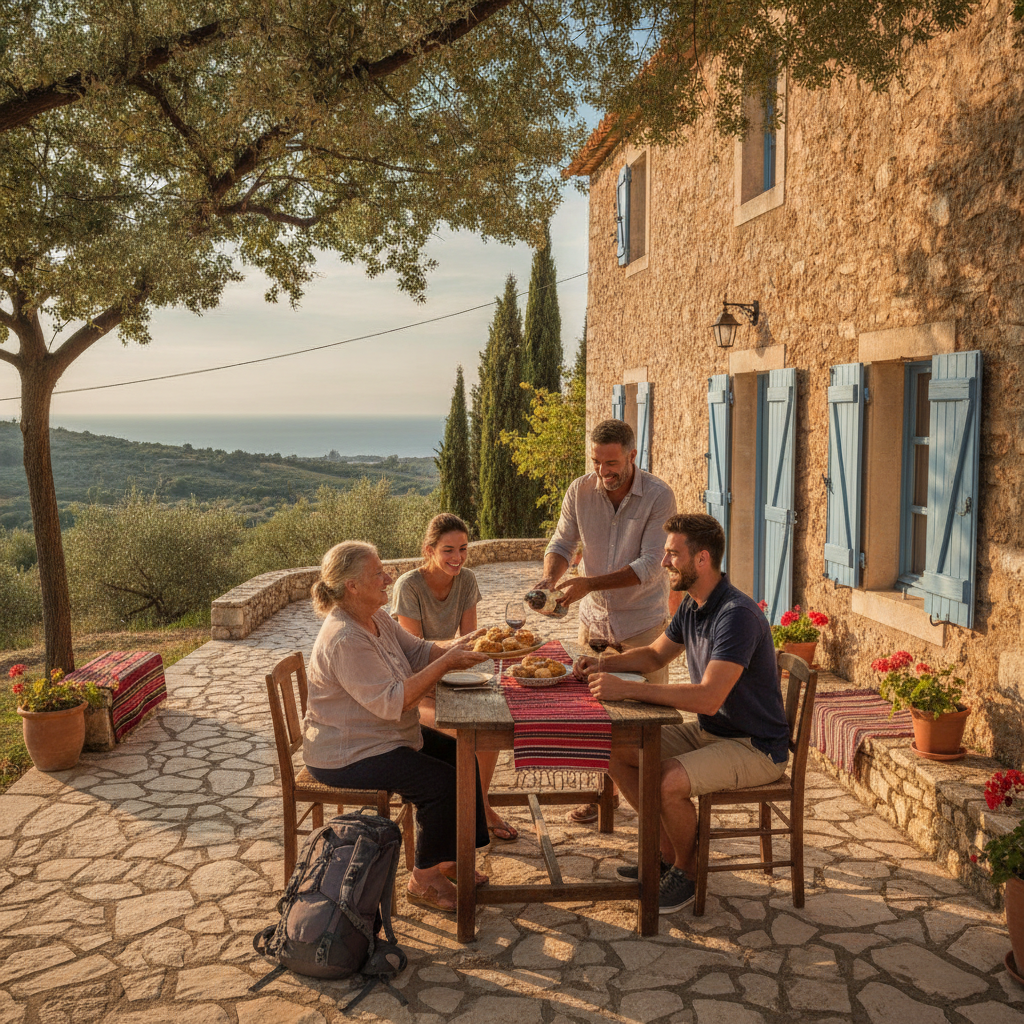
One of the quieter effects of staying in a family guesthouse is that it makes slow travel easier almost by accident. There's no app checkout, no loyalty points to mentally account for, no floor of identical corridors to disorient a half-asleep traveler. Instead, there's a courtyard where breakfast gets set out at a specific hour, a host who notices when someone comes back late and leaves a note about the door latch, and the small, humanizing texture of living briefly inside someone else's domestic world. This texture slows perception in the best possible sense. A traveler notices more — the light at a particular time of morning, the sound of the neighborhood waking up, the way the host interacts with whoever delivers bread. These details don't appear in any review or ranking. They accumulate quietly and become, in memory, the substance of the trip itself.
The Language of Hospitality Carries Cultural Weight
Many family-run accommodations carry within them a specific cultural philosophy of hosting that the word "hospitality" in English only partially captures. In Georgia — the country — the concept of *mikhedroba* refers to a sense of protective generosity toward guests that goes beyond service; a guest is treated as something close to sacred. In parts of Morocco, the tradition of welcoming strangers into a riad reflects a value system in which hospitality is not a transaction but an expression of character. Staying in a family guesthouse in these contexts means encountering that philosophy directly, through the way a meal is offered or a problem is solved. It's an education that no amount of reading fully substitutes for, because it arrives through gesture, timing, and tone rather than explanation.
What the Trip Becomes When the Logic Shifts
When you choose a guesthouse run by a local family, the trip stops being a sequence of attractions connected by transit and becomes something closer to an immersion. The hotel is no longer neutral ground — it's a starting point with a perspective, a set of opinions about the city, and a genuine stake in your experience of it. Recommendations feel different because they come from someone who will see you at breakfast the next morning. Mistakes become stories because someone was there when they happened. The rhythm of each day is shaped partly by the household's own rhythm, which pulls a traveler out of the tourist circuit and into something more ordinary and therefore more real. That shift in logic — from managed convenience to lived proximity — is not always comfortable, and it's not always seamless. But it tends to produce the kind of travel that stays with a person long after the flight home.
The hallway that smells of cardamom doesn't make a trip better by any metric a booking platform measures. It makes it better in the way that any genuine encounter with another person's life does — by adding weight, texture, and the faint, persistent sense that the world is more particular and more interesting than a standardized room rate would suggest.