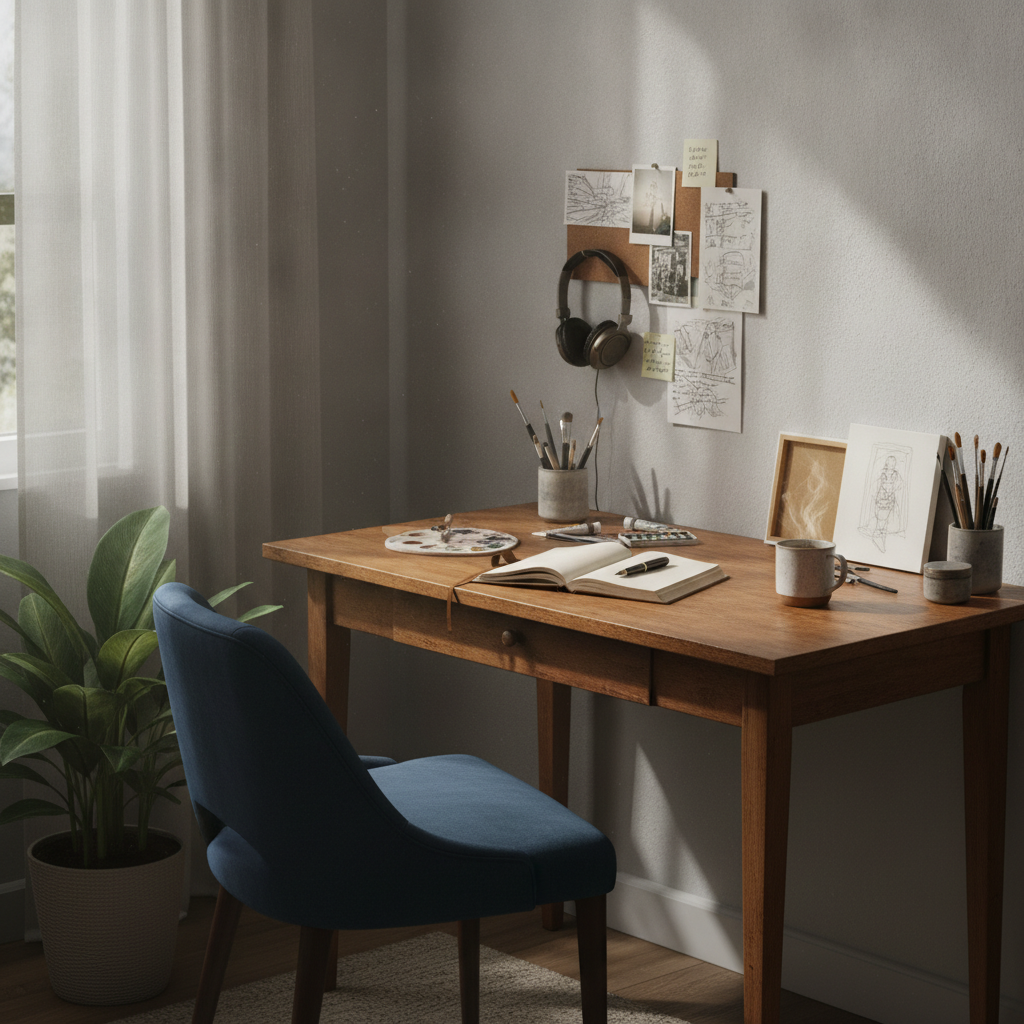
The environments people inhabit shape their mental states in ways that are far more direct than most realize. A cluttered kitchen table used for everything from bill-sorting to weekend craft projects sends the brain a diffuse signal — one that makes settling into concentrated, generative work genuinely harder. By contrast, a space that exists for a single purpose builds a kind of silent expectation over time, one that the nervous system learns to recognize and respond to before a single task has even begun.
The Brain's Relationship With Environmental Cues
Human cognition is deeply context-dependent, shaped continuously by physical surroundings. Researchers in behavioral neuroscience have long understood that the brain uses environmental cues — lighting, surface texture, spatial arrangement, even scent — as shorthand for predicting what kind of activity is about to happen. When a person consistently associates a particular corner of a room with focused creative work, that space begins to function almost like a conditioned trigger. The mind starts the process of narrowing attention simply by entering it, reducing the internal effort required to shift from a scattered state into something more productive and sustained.
Why Multipurpose Surfaces Undermine Creative Momentum
The problem with working at a kitchen table or on a living room couch isn't merely aesthetic — it's neurological. Multipurpose surfaces carry residual associations from every activity that's taken place there: meals, conversations, phone scrolling, homework, arguments. These associations don't disappear when a laptop opens or a sketchbook appears. Instead, they compete quietly with the task at hand, requiring the brain to work against its own context-reading tendencies. Designers like those behind the Studio Neat line of minimalist tools have long argued that environment conditions behavior — a principle that applies as much to creative output as it does to product design.
The Surprising Power of Even a Small Dedicated Area
A dedicated creative space doesn't require a separate room, a renovation, or a significant budget. A single corner of a bedroom, a specific chair positioned near a window, or a folding desk set up only during creative hours can carry the same psychological weight as a purpose-built studio — provided it's used consistently and kept relatively distinct from other activities. In neighborhoods like Brooklyn's Gowanus or East London's Hackney, where artists and writers have historically claimed modest corners of shared apartments as functional studios, the principle has always been the same: intention and consistency matter far more than square footage.
How Ritual Objects and Spatial Anchors Reinforce the Shift
Beyond the physical boundaries of a space, small objects placed within it can deepen the conditioned response over time. A specific lamp switched on only during creative sessions, a particular notebook left open on the desk, or even a playlist queued through an app like Brain.fm — these become sensory anchors that signal to the nervous system that focused work is beginning. The more consistently these elements appear together in the same location, the faster the internal shift happens. Over weeks and months, the transition from distracted to focused can compress from twenty minutes of restless settling to something closer to two or three.
The Long-Term Effect on Creative Output and Consistency
People who maintain dedicated creative spaces — even modest ones — tend to report that their creative work feels less effortful to begin, not because the work itself becomes easier, but because the activation energy required to start drops significantly. This reduced friction has a compounding effect: when beginning feels manageable, people return more frequently, and return is the mechanism through which creative habits actually deepen. Journals, manuscripts, visual art collections, and music projects that stall almost always stall at the threshold — not in the middle of a session, but in the gap between intention and action that a well-designed space helps close.
Building Your Own Dedicated Creative Corner
Choosing and establishing a creative space works best when approached as a gradual, deliberate process rather than a single organizational overhaul. Start by identifying a spot that is already relatively low-traffic and can hold a surface — even a small one. Clear it of anything unrelated to creative work, and resist the temptation to use it for email, casual scrolling, or administrative tasks. Bring in one or two objects that feel intentional: a good lamp, a quality sketchbook, a set of pens you actually enjoy using. Keep the space tidy enough that sitting down there doesn't require a preliminary cleanup, because that friction will quietly discourage you from beginning. Use it at roughly the same time each day or week, and let the association build on its own terms — the brain responds to repetition more reliably than to motivation.
The simple act of assigning physical space to creative work is, in the end, an act of taking that work seriously. The brain responds to commitment made visible in the environment, and a corner claimed for focused creative effort becomes, over time, a reliable ally in the ongoing effort to produce something meaningful from ordinary days.