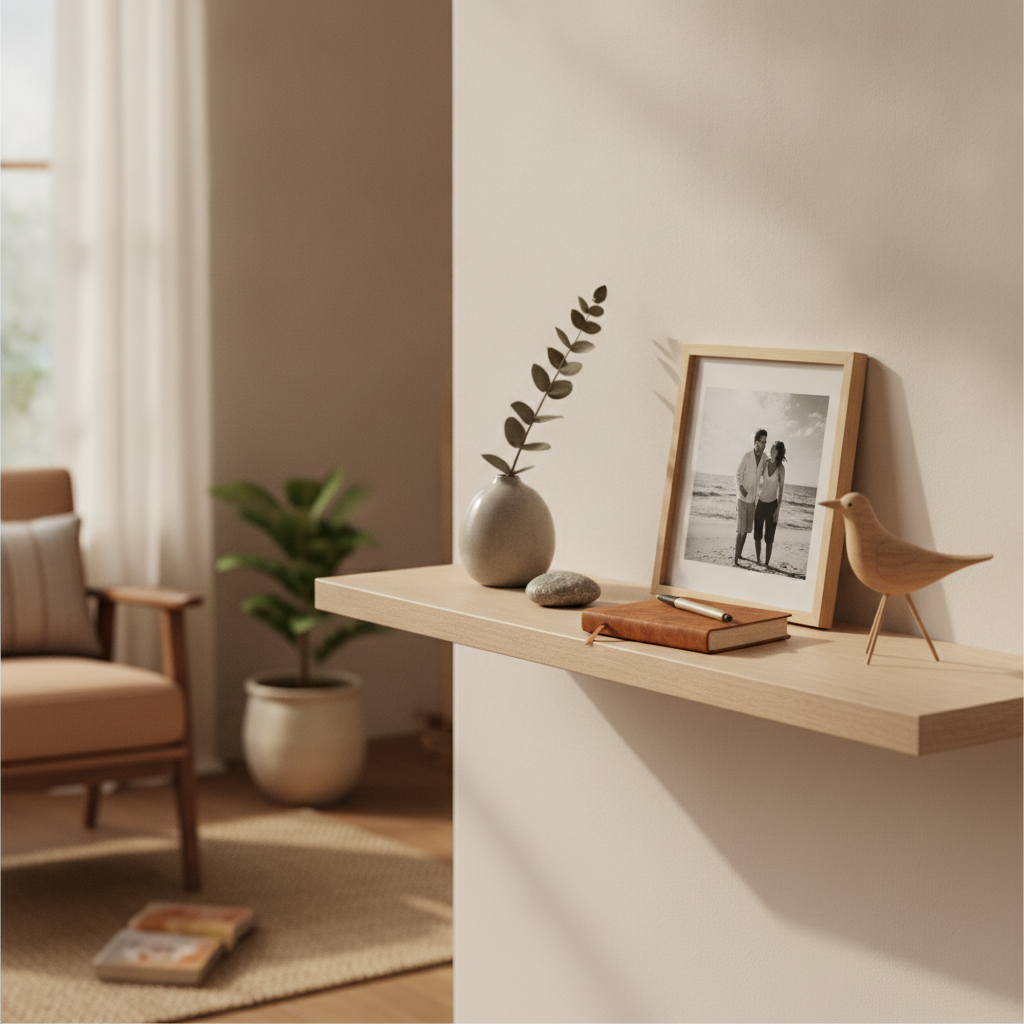
Most people decorate their homes to fill space, and in doing so, they create environments that speak loudly about accumulation rather than quietly about meaning. The instinct to cover every surface, to dress every corner, is understandable — it feels productive, even expressive. But the spaces that tend to genuinely nourish the people who inhabit them are rarely the most decorated ones. They are, almost without exception, the most considered ones.
What Does Visual Noise Actually Cost the Mind?
The human eye is not a passive instrument. Every object within a field of vision registers in the brain, however briefly, and that registration carries a small cognitive cost. In environments crowded with decoration — layered shelves, clustered frames, collected trinkets across every ledge — the mind is continuously processing stimuli that offer no particular reward. Psychologists who study environmental psychology refer to this phenomenon as *attentional fatigue*, a gradual depletion of the mental resources available for focus, decision-making, and emotional regulation. A heavily decorated room can feel stimulating at first, but over hours and days, it quietly drains the very calm it was meant to create.
How Does the Japanese Concept of Ma Reframe Empty Space?
In Japanese aesthetics, the concept of *ma* (間) refers to the meaningful pause or empty interval between objects — the idea that space itself carries presence and significance rather than representing absence. This principle shapes everything from the arrangement of a traditional *tokonoma* (a recessed alcove in Japanese rooms, traditionally used to display a single scroll, flower arrangement, or art object) to the spare interiors found in the ryokans of Kyoto. Within a tokonoma, one object is displayed with full intentionality, then changed with the seasons. The lesson is that removing competing objects doesn't diminish the remaining one — it elevates it. Western interiors rarely honor this principle, but homes that do tend to produce a distinct and lasting sense of calm in their occupants.
Why Does a Single Shelf Create More Psychological Anchoring Than a Full Room?
When a person curates a single shelf — selecting five or six objects that carry genuine personal weight, arranging them with care, and resisting the impulse to keep adding — something functionally important happens. That shelf becomes a focal point, a place the eye returns to voluntarily rather than being pushed toward by quantity. Objects on such a shelf tend to accumulate what might be called *object biography*: the worn corner of a book read during a formative year, a stone brought back from the Cinque Terre, a small ceramic piece made by hand. The shelf functions less as decoration and more as a quiet form of autobiography, and interacting with it — even glancing at it — connects a person to something durable about themselves.
How Does Editing Objects Down Sharpen What Actually Matters?
The process of selecting which objects belong on a curated shelf is itself meaningful. It requires a kind of ruthless honesty about which things actually hold feeling and which merely occupy space out of inertia. Many people discover, when they begin this process, that most of what they've displayed was chosen for reasons that no longer apply — gifts kept out of obligation, objects purchased during a decorating impulse, inherited pieces that carry more guilt than meaning. The Swedish practice of *döstädning* (death cleaning — a method of thoughtful decluttering, made widely known by Margareta Magnusson's writing), encourages exactly this kind of interrogation, not as a morbid exercise but as a clarifying one. What remains after the editing tends to be exactly the right amount.
What Role Does Ritual Play in Relating to a Curated Shelf?
A meaningful shelf invites a different kind of daily interaction than a decorated room does. Because the objects are few and deliberately chosen, a person tends to actually see them rather than visually skim past them. Some people rotate objects seasonally — bringing in something that speaks to autumn or to a particular mood — which keeps the shelf alive rather than static. Others treat the act of dusting or rearranging it as a brief, grounding ritual. The Danish concept of *hygge* (a quality of coziness and convivial warmth that promotes wellbeing), often misrepresented as a matter of candles and blankets, is more accurately about the quality of attention brought to a space. A curated shelf is, in this sense, a form of daily hygge that requires almost no effort to maintain once established.
How Does a Minimal Display Affect Guests and Shared Living Spaces?
There is a social dimension to how objects are displayed that is easy to overlook. A room decorated densely tends to communicate information about the inhabitant in bulk — it shows everything at once, leaving little room for conversation to discover. A carefully curated shelf, by contrast, invites genuine curiosity. Guests notice individual objects and ask about them, and those questions open real conversations rather than general comments about how a room looks. In shared living spaces — apartments in cities like Amsterdam or Montreal, where multiple people occupy close quarters — a single shelf can also function as a negotiated territory, a place where each person contributes one or two objects without imposing their entire aesthetic sensibility on a shared room.
How Should You Begin Curating Your Own Shelf?
Beginning is less complicated than it appears, and the only real requirement is a willingness to be honest about what holds meaning and what simply holds space. Choose a single shelf — one at eye level if possible, in a room where you spend genuine time rather than simply pass through. Remove everything from it first, and sit with the empty surface for a day before putting anything back. When you return to it, bring only what you'd choose to keep if you were moving abroad for a year and could take very little. A photograph, a book that changed something in you, a small object that connects to a place or a person. Arrange them with space between them. Then stop. The shelf will tell you when it's right — there's a particular stillness that arrives when a space has exactly what it needs and nothing more, and it's recognizable the moment it appears.
Decoration, at its most honest, was never meant to fill rooms. It was meant to hold meaning — and meaning, it turns out, doesn't need much space to breathe.