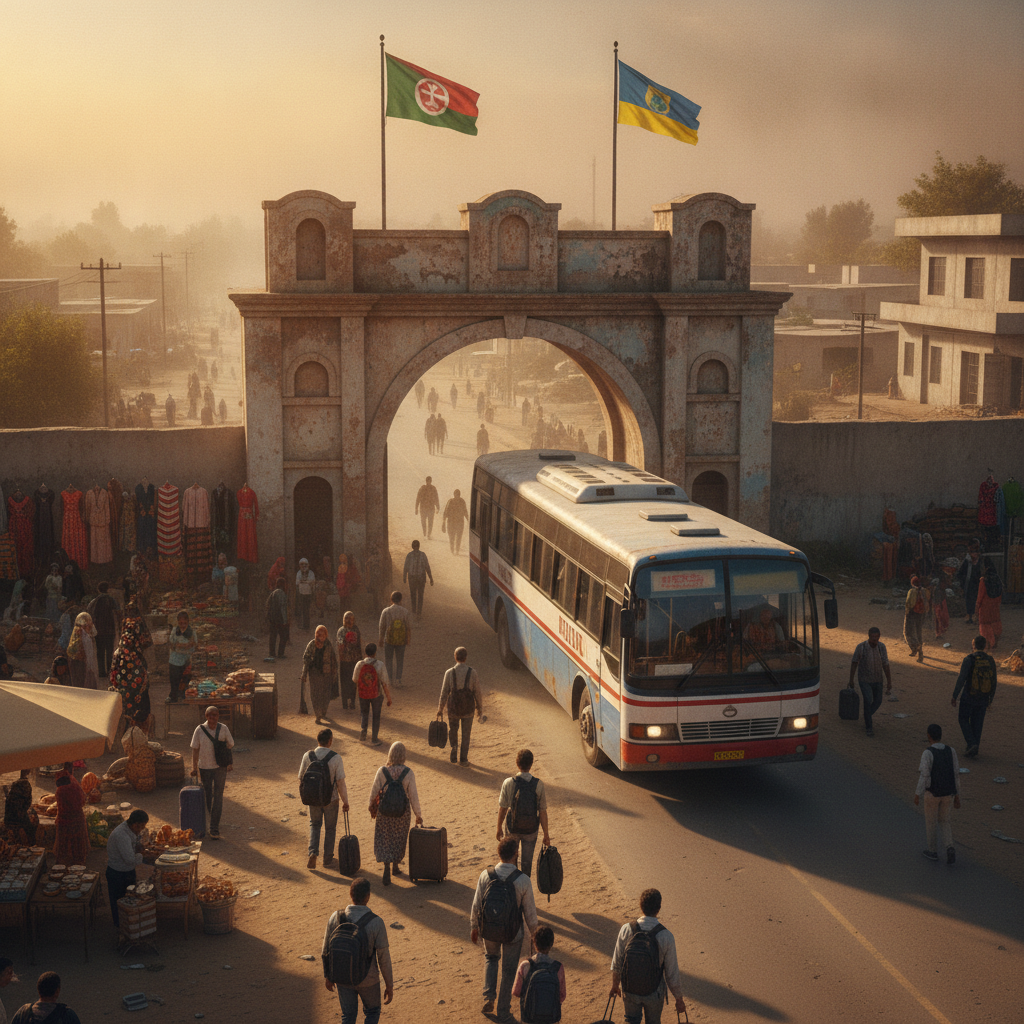
There is something quietly disorienting about stepping off a plane into a country you've never visited before. One moment you're inside the familiar, pressurized sameness of an aircraft cabin — the same overhead bins, the same recycled air, the same branded cups — and the next, you're standing in a foreign arrivals hall, blinking in new light, with no geographical memory of how you got there. The two places exist in your mind as a sudden rupture rather than a gradual transition. That rupture is not inevitable. It is, in large part, a product of how you chose to travel.
The Geography You Miss at 35,000 Feet
When a traveler boards a bus from, say, Chiang Mai toward the Laotian border crossing at Huay Xai, something begins to happen long before the immigration stamp. The landscape changes incrementally — the density of towns thins, the road climbs and curves, the signage shifts in small ways, the roadside vendors' goods begin to tell a different story. This gradual geographic unfolding is something that air travel simply removes from the equation. Flying compresses space into irrelevance and deposits the traveler with no earned context, no visual memory of the terrain between. The overland traveler, by contrast, carries a mental map built from observation — a map that makes arrival feel less like teleportation and more like continuation. That distinction changes, in subtle but meaningful ways, how a place is first perceived and how quickly it begins to make sense.
The Border Zone as a Cultural Threshold
Border crossings by land have their own particular atmosphere, one that air travelers almost never encounter in its full texture. The zone between two countries — the stretch of road or bridge or checkpoint that belongs, in a sense, to neither — operates as a kind of liminal space, a term borrowed from anthropology meaning a threshold state between two conditions. In places like the Poi Pet crossing between Thailand and Cambodia, or the busy pedestrian bridge linking Foz do Iguaçu in Brazil with Ciudad del Este in Paraguay, this in-between space is vivid and chaotic and deeply informative. The mix of languages being spoken, the shift in currency being exchanged, the change in vendor goods on either side — all of this produces a form of cultural literacy that no airport arrival lounge can replicate. The traveler who moves through it slowly, on foot or by bus, absorbs a transition that their nervous system registers as genuine.
What Slow Arrival Does to First Impressions
The psychology of arrival matters more than most itinerary-planners acknowledge. When the body has moved through space gradually, when it has registered the changing light and temperature and human density across several hours of ground travel, the brain arrives at a new destination in a more receptive state. There's less cognitive shock to manage. The overland traveler who crosses from Sarajevo into Montenegro by coach has already seen the landscape shift from one architectural character to another, has already heard the language change in pitch and rhythm at roadside stops, and arrives with a richer frame of reference than someone who flew into Podgorica with no connective tissue between the two experiences. First impressions formed in this state tend to be more accurate, more nuanced, and more durable — they're built on accumulated context rather than constructed from scratch in the first bewildering hour.
Language, Currency, and the Small Signals of Change
One of the quieter pleasures of overland border travel is the way it draws attention to the small signals of cultural shift that might otherwise go unnoticed. The denominations on banknotes, the fonts on shop signs, the way locals hold themselves in line at a checkpoint — these are details that register almost unconsciously but add up to something real. The traveler crossing from Colombia into Ecuador by bus through Ipiales notices the precise moment when cumbia fades from a driver's radio and something quieter takes its place. Those who have learned even a handful of phrases in each language — a practice that local residents invariably reward with warmth — find that the border crossing becomes a kind of linguistic calibration point, a moment to shift registers rather than start from zero. The cultural term here is code-switching, the practice of adjusting language and behavior to match a new social context, and overland travel makes it feel natural rather than abrupt.
What You Carry Into the Next Country
You don't leave one culture behind at a border. You carry it with you, layered under the new one that's just beginning. This is what the overland crossing makes visible in a way that flying does not. The traveler who arrives in Vietnam having spent two weeks in Cambodia and moved through the land border near Moc Bai doesn't experience Vietnam as a blank slate — they arrive with a comparative framework, an awareness of contrast and continuity that deepens everything they observe. The French colonial architecture that persists in both countries reads differently when you've moved between them by road. The regional food traditions, which overlap and diverge in ways that no single country's cuisine can explain, become part of an ongoing conversation rather than an isolated fact. The overland journey builds a kind of regional intelligence that accumulates with distance.
Choosing the Ground Route Deliberately
For travelers considering routes through Southeast Asia, Central America, or the Balkans — regions where overland travel between countries is practical and well-served — the bus or shared minivan is often dismissed in favor of budget airlines like AirAsia or Volaris on the basis of time and cost. But the calculus changes when the journey itself is treated as part of the trip's value rather than a logistical inconvenience. Choosing the bus from Antigua to San Cristóbal de las Casas, or the overnight coach from Belgrade to Skopje, is not merely a budget decision — it is a decision about what kind of traveler you want to be and what kind of knowledge you want to carry forward. The hours on the road are rarely wasted. They are, more often than not, the hours that make the destination make sense when you finally arrive.
There is a version of travel that begins at the airport and ends there — clean, efficient, and strangely abstract. And then there is the version that begins in one place and walks, slowly and on the ground, into the next. The traveler who steps off a bus in a new country, having watched the world change around them for the better part of a day, carries something the other traveler does not: the memory of the space between, and the understanding that cultures do not begin and end at passport control, but bleed and blur and shift across every kilometer of road in between.